

Around Rialto Bridge, Venice

Around Rialto Bridge (Self Guided), Venice

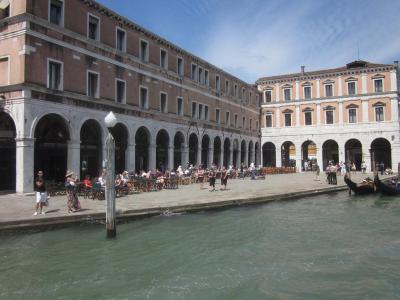
The Rialto district represents the earliest urban and commercial core of Venice that has shaped the city’s identity for centuries. Long before grand palaces lined the canals or empires were managed from marble halls, this was the practical heart of the lagoon. Its name comes from Rivo Alto, meaning “high bank,” a rare patch of ground that stayed relatively dry and therefore attracted settlers as early as the 9th century. Stability mattered here—both literally and financially—and Rialto quickly became the place where things happened.

By the 11th century, Rialto was already running Venice’s main market and its earliest banking system, all under watchful state control. Spices, silk, grain, fish, and precious metals passed through its stalls and warehouses, while contracts were signed, loans negotiated, and currencies exchanged nearby. Foreign merchants were kept on a tight leash inside supervised warehouses called “fondachi,” and money-changers and notaries quite often worked overtime. The result was a tightly organized commercial machine that made Rialto one of medieval Europe’s most sophisticated business districts.

Geography helped. The Grand Canal narrows here, turning Rialto into a natural crossing point between the city’s eastern and western halves. Before stone replaced wood, a succession of wooden bridges spanned the canal—many of them burning down or collapsing under the strain of constant traffic. Indeed, this was a place of noise and movement: sailors shouting, porters rushing, officials counting, and deals being struck alongside gossip and news. A major fire in 1514 nearly wiped the district out, leaving the Church of San Giacomo as one of the few survivors.

The stone Rialto Bridge, completed in 1591, settled the matter for good. Even as Venice’s global influence began to face competition, Rialto stayed firmly in charge of the city’s everyday economy. Political power gradually drifted toward San Marco, but the local markets continued to supply Venetians with food and goods, preserving commercial traditions rooted in centuries of trade.

That layered history still defines Rialto today. Markets, churches, old financial buildings, and long-standing shops share the same tight streets, keeping the district busy, loud, and unmistakably alive. Rialto is not a museum quarter—it’s Venice at work, doing what it has always done best. So, take this self-guided tour and walk its bridges and markets slowly. Follow the flow of people rather than signs, and experience Venice where it has always been most itself.
How it works: Download the app "GPSmyCity: Walks in 1K+ Cities" from Apple App Store or Google Play Store to your mobile phone or tablet. The app turns your mobile device into a personal tour guide and its built-in GPS navigation functions guide you from one tour stop to next. The app works offline, so no data plan is needed when traveling abroad.

Download The GPSmyCity App

Around Rialto Bridge Map

Guide Name: Around Rialto Bridge
Guide Location: Italy » Venice (See other walking tours in Venice)
Guide Type: Self-guided Walking Tour (Sightseeing)
# of Attractions: 8
Tour Duration: 1 Hour(s)
Travel Distance: 0.4 Km or 0.2 Miles
Author: DanaOffice
Sight(s) Featured in This Guide:
  • Ponte di Rialto (Rialto Bridge)
  • Emilio Ceccato
  • Palazzo dei Camerlenghi (Camerlenghi Palace)
  • Chiesa di San Giacomo di Rialto (Church of St. James of Rialto)
  • Osteria Bancogiro
  • Chiesa di San Giovanni Elemosinario (Church of St. John the Almsgiver)
  • Mercato di Rialto (Rialto Food Market)
  • Mercatino Antiquariato Campo San Maurizio (Antiques Market)
1
Ponte di Rialto (Rialto Bridge)

1) Ponte di Rialto (Rialto Bridge) (must see)

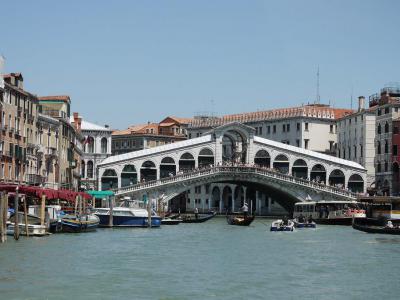
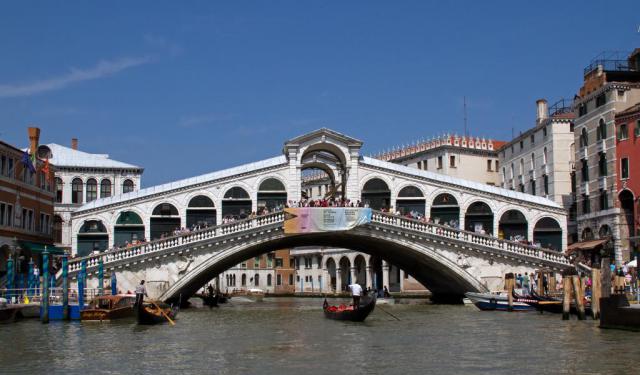
There are only four bridges that cross Venice’s Grand Canal, so sooner or later, your feet will lead you onto one of them. Odds are, it will be the Rialto Bridge—the oldest, busiest, and most talked-about of the lot. This single stone arch links the districts of San Marco and San Polo, effectively stitching together the eastern and western parts of the city.

The first bridge here went up in the 12th century and was made of wood, which, given Venice’s relationship with water, was always going to be a temporary arrangement. In the late 1500s, it was replaced by the stone bridge you see now. At the time, critics were convinced it would collapse under its own ambition. Architects shook their heads, predictions were made, and history politely ignored them all. The bridge not only survived but thrived—remaining the only pedestrian crossing over the Grand Canal until the Accademia Bridge arrived in 1854.

Crossing the Rialto today is a sensory workout. The flow of people never really stops, but if you manage to claim a patch of railing, the payoff is worth it. The Grand Canal stretches open in both directions, lined with palaces that look like they’re posing for a portrait. Just beyond the souvenir stands, the mood shifts. The Rialto markets take over, continuing a trade tradition that goes back centuries. Stalls pile up with fruit and vegetables grown on the lagoon islands, while fish fresh from the Adriatic glints on ice. Look closely, and you might spot boats unloading the day’s catch, straight from Burano or Pellestrina.

Around the bridge, shops and restaurants cluster tightly, many of them on the expensive side, but discreetly blended into the historic fabric. And then there are the gondoliers—casually leaning, coincidentally available, and very certain that this moment is perfect for a ride.

One final note: come back in the evening. The crowds thin, the light softens, and the Rialto Bridge finally has room to breathe—and so do you...
2
Emilio Ceccato

2) Emilio Ceccato

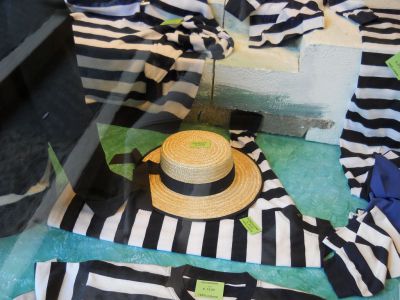
Just steps from the Rialto Bridge, Emilio Ceccato looks like a shop—but behaves more like a time capsule that never stopped doing business. Emilio Ceccato, a long-established Venetian clothing store closely associated with the iconic image of the city’s gondoliers. Striped shirts, wool caps, loose trousers, sturdy jackets, and waterproof bags, all drawn straight from their working wardrobe. Practical, unmistakable, and quietly elegant, they are the clothes shaped by water, weather, and repetition, rather than trends...

The store's story began in 1866, when Giorgio Ceccato opened a jewelry shop in this very space, under the same wooden sign that still hangs above the door. Over time, the sparkle shifted from gemstones to fabric. Archival evidence, including a carpenter’s invoice, records an early renovation that marked the shop’s gradual transition into clothing and accessories. By 1897, the business passed to Giorgio’s son Emilio, who steered it toward high-quality haberdashery—items chosen not for decoration alone, but for durability, balance, and visual restraint.

Years on, Emilio Ceccato doesn't freeze itself in nostalgia. This is not merely costume-making; it’s continuity. The shop is an official partner of the Gondoliers Association, supplying garments that are still worn on the water today. That partnership goes beyond outfitting: part of the proceeds supports gondola-making traditions, training future gondoliers, and keeping the specialized crafts of the trade alive.

So, whenever you're here, remember—you’re not simply shopping but brushing up against a working system that has dressed Venice for generations. Emilio Ceccato is where fabric, labor, and identity are stitched together, one stripe after another...
3
Palazzo dei Camerlenghi (Camerlenghi Palace)

3) Palazzo dei Camerlenghi (Camerlenghi Palace)

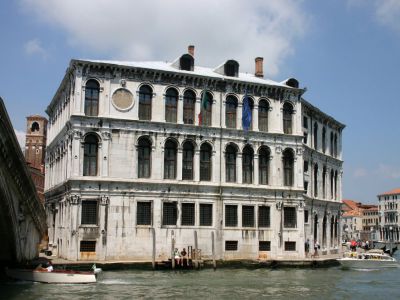
Standing right at the foot of the Rialto Bridge, the Camerlenghi Palace looks elegant enough—until you learn what went on inside. Completed in 1488 and expanded in the 1520s, this was Venice’s financial nerve center, home to the Camerlenghi, the Consuls of the Traders, and other officials tasked with keeping the republic’s money in line. Think spreadsheets before spreadsheets, backed by serious authority...

Now for the persuasive part of Venetian accounting. The palace’s ground floor doubled as a debtors’ prison. Miss your payments, and you could find yourself locked up right beside one of the busiest crossings in the city. The location was no accident. Placing debtors in full view of Rialto’s constant traffic served as a public warning—pay your bills, or enjoy the view from behind bars. The nearby canalside even picked up the name “the Foundations of Prisons,” a reminder that Venice believed in financial responsibility, with visual aids...

Inside the upper floors, things took a more cultured turn. Venetian custom dictated that departing magistrates leave behind religious paintings or portraits in their former offices. Over time, this turned the palace into an accidental art gallery, filled with images promoting civic duty, moral order, and social ideals. That collection didn’t survive intact. During the French occupation, many works were removed; some later made their way back to Venice, settling not here, but in the Gallery of the Academy.

Today, the palace has traded Renaissance accountants for modern ones, housing regional offices of Italy’s state auditing authority. Architecturally, it still follows the curve of the Grand Canal with quiet confidence. Tall windows, decorative friezes, and faux columns give it rhythm and restraint, even if the original colored marbles are long gone. It’s a building that proves Venice didn’t just master trade—it mastered how to make money behave...
4
Chiesa di San Giacomo di Rialto (Church of St. James of Rialto)

4) Chiesa di San Giacomo di Rialto (Church of St. James of Rialto)

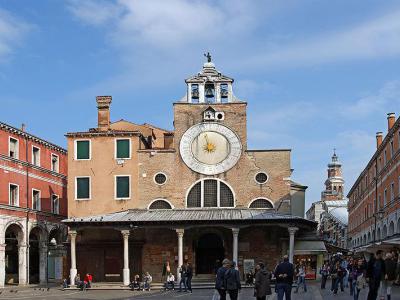
According to local legend, the first church on this spot appeared in the 5th century, right around the time people decided this patch of higher ground was a good place to stay dry. If that story holds, this would be the oldest church in Venice. The building you see today came later, constructed between the 11th and 12th centuries with a very practical audience in mind: the merchants of Rialto, who preferred not to walk far between business and prayer.

A major restoration followed in 1601, but the church kept its most distinctive features, including its original Gothic portico—one of only two left in the city—and the oversized 15th-century clock on the façade. The clock runs on a 24-hour system and has never been especially reliable, a fact Venetians have cheerfully mocked for centuries.

The square outside the church has its own distinctive features, too. On the far side stands a crouching stone figure known as the Gobbo of the Rialto. In the 16th century, this was the finishing line for public punishments: minor offenders were forced to run all the way from Piazza San Marco to here, providing entertainment for anyone who happened to be watching.

Inside the church, the tone shifts from spectacle to history. Six columns topped with Veneto-Byzantine capitals, carved from ancient Greek marble, date back to the 11th century. Around the outside of the apse, a 12th-century inscription delivers a message clearly aimed at the surrounding market stalls: “Let the merchant’s law be just, his weights accurate, and his promises trustworthy.” Indeed, this church in Rialto knew exactly who its congregation was...
5
Osteria Bancogiro

5) Osteria Bancogiro

Set right in the thick of things, Osteria Bancogiro restaurant finds itself between the Rialto food market and the Rialto Bridge, with the Grand Canal sliding past its doorstep. Its name isn’t decorative: bancogiro refers to the nearby portico where financial accounts were once settled, meaning money changed hands here long before menus did. That legacy still fits. This is a place defined by movement, exchange, and the steady flow of people through one of Venice’s most active zones.

Bancogiro has the soul of a traditional Venetian trattoria, but it doesn’t feel stuck in the past. The kitchen keeps things grounded in lagoon and Adriatic cooking, letting seafood lead without fuss. Seasonal ingredients set the pace, sauces stay light, and presentation doesn’t shout for attention. Expect raw fish preparations, marinated anchovies, and cicchetti-style bite-sized plates that mirror how Venetians actually eat, alongside pasta, risotto, and daily fish dishes for those settling in properly.

The bar counter is where the energy peaks. Locals and visitors lean in for a glass of wine and something small to eat, often treating Bancogiro as a pause in the day rather than a sit-down event. The wine list keeps its focus close to home, with strong representation from Veneto and across Italy, making it easy to stay for one glass—or several... Upstairs, the pace slows. The dining room offers a more classic restaurant setting, and during busy hours, booking ahead is a wise move.

The interior mixes clean, modern lines with subtle nods to Venice’s trading past, keeping the atmosphere contemporary without erasing context. Outside, canal-facing tables deliver a front-row view of boats, deliveries, and daily life on the water.

Bancogiro isn’t trying to be a secret or a sanctuary. It works best as a public crossroads—lively, dependable, and tuned to the rhythm of the city. If you want a clear, honest taste of how Venice eats today, this is a very good place to stop and enjoy.
6
Chiesa di San Giovanni Elemosinario (Church of St. John the Almsgiver)

6) Chiesa di San Giovanni Elemosinario (Church of St. John the Almsgiver)

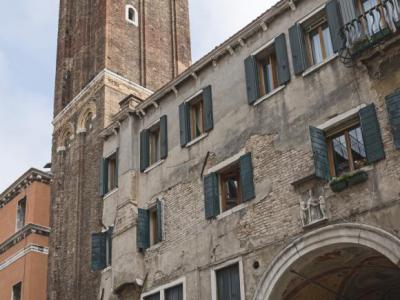
The Church of Saint John the Almsgiver is easy to miss—and that’s part of the story. Wedged tightly between neighboring buildings, it keeps a low profile, with only its 15th-century bell tower rising above the rooftops to announce that a church is even here.

Founded in the 11th century, it nearly vanished in the devastating fire of 1514 that tore through the Rialto area. The blaze spared just the bell tower. When the church was rebuilt between 1527 and 1529, under designs by Antonio Abbondi (generally known as Scarpagnino), the tower gained a new civic role: each evening, its bell rang to signal that all fires in the district were to be put out—an early form of urban fire control in a neighborhood that had learned its lesson the hard way...

Once inside, the mood pivots from everyday utility to painted spectacle. Most of what you see dates from the decades after the reconstruction, when the church became a showcase for Venetian art. Several works by Palma il Giovane line the interior, alongside paintings by Leonardo Corona. The visual anchor, however, is the high altarpiece by Titian, Saint John the Almsgiver, depicting the 7th-century Patriarch of Alexandria as a figure of authority tempered by charity.

Nearby, Italian Mannerist painter Pordenone delivers a very different kind of energy in Saints Catherine, Sebastian, and Roch: a powerfully built Sebastian, almost defiantly exposed; a focused Saint Catherine, eyes lifted skyward; and Saint Roch casually revealing a healed leg—a quiet nod to survival after the plague. Look up to the cupola, and you’ll find Pordenone again, this time filling the space with sturdy, muscular cherubs that feel more physical than ethereal.

Indeed, for a church that hides so well on the outside, it leaves a strong impression once you’re in.
7
Mercato di Rialto (Rialto Food Market)

7) Mercato di Rialto (Rialto Food Market) (must see)

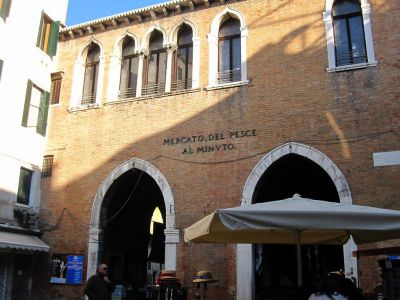
If Venice had a daily heartbeat, you’d hear it loud and clear at the Rialto Market. This is where the city does its shopping, chatting, and a fair bit of arguing over fish, too. It may look theatrical at first glance, but make no mistake—this is not a show put on for visitors. It’s a working market, busy, loud, and unapologetically real, which is exactly why it feels so alive.

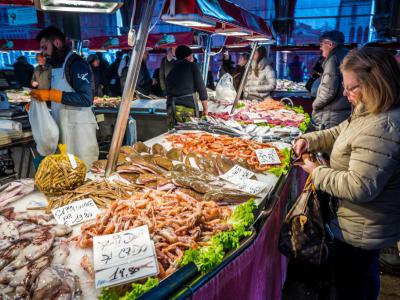
The setting does most of the heavy lifting. The market opens directly onto the Grand Canal, a position it has held since the 11th century, back when boats mattered more than pavements. Vendors unload their goods as they have for hundreds of years, surrounded by handwritten signs that are small works of art in their own right. These aren’t just price tags. They explain where the produce comes from, what it tastes like, and occasionally how you might cook it later. A kind of grocery list meeting gallery wall, with a strong Venetian accent...

What you’ll find here is both practical and visually irresistible. Flowers spill from buckets, spices perfume the air, and stalls overflow with seasonal fruit and vegetables. Fresh meat and seafood dominate the scene, with surprisingly reasonable prices for such a famous location. Some fish will look familiar, but much of it won’t. Cuttlefish, for example, are a local staple, prized for the ink that turns Venetian pasta a dramatic black. Shellfish of every shape and size pile up on beds of ice, glistening under the morning light. Even if you buy nothing, merely watching the rhythm of buying, selling, and bargaining is a full sensory experience—and yes, your camera will get a workout...

One small note on manners. This is a place where locals shop, not a museum with velvet ropes. Try to stay out of the way, keep moving when space is tight, and always ask before touching anything on display. Do that, and the Rialto Market will reward you with one of the most honest glimpses of everyday Venice you’re likely to find.
8
Mercatino Antiquariato Campo San Maurizio (Antiques Market)

8) Mercatino Antiquariato Campo San Maurizio (Antiques Market)

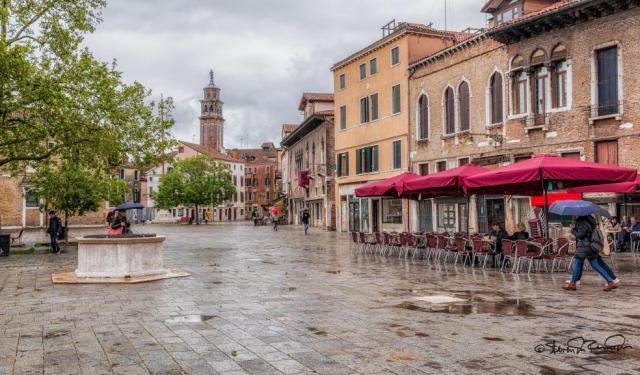
Set your pace to unhurried, because the market in San Maurizio Square does not reward rushing. This is one of Venice’s longest-running open-air antique markets, and it feels perfectly at home in its setting. The square itself is compact but layered, framed by Gothic palaces like Bellavite, Molin, and Zaguri, with the neoclassical façade of the Church of San Maurizio presiding calmly over the scene. It’s the kind of square that seems to have been waiting centuries for tables of old objects to appear.

The market has been operating for decades, and it shows—in a good way. This isn’t a place for novelty souvenirs or fast selling. Collectors, seasoned dealers, locals, and quietly curious visitors all move at roughly the same tempo. The atmosphere is measured and conversational, closer to a scholarly exchange than a sales pitch. Most stalls are run by experienced dealers from Venice and northern Italy, people who prefer explaining an object’s history to haggling aggressively over its price.

What you won’t find here are oversized wardrobes or dramatic furniture pieces. What you will find are the things that fit in the hands and invite closer inspection: old books, prints, engravings, maps, postcards, clocks, devotional items, silverware, jewelry, Murano glass, and small, carefully chosen curiosities from roughly the 18th to early 20th centuries. The conversations drift naturally toward materials, techniques, and provenance, with bargaining kept polite, informed, and refreshingly low-key.

The real charm of the Mercatino lies in how seamlessly it blends into the square. Nautical motifs, travel documents, and printed ephemera quietly echo Venice’s maritime and diplomatic past, without ever spelling it out. Held on selected weekends in April, June, September, October, and December, this market offers a tactile, grounded way to connect with the city’s layered history—one object, one conversation, and one unhurried glance at a time...

Walking Tours in Venice, Italy

Create Your Own Walk in Venice

Create Your Own Walk in Venice

Creating your own self-guided walk in Venice is easy and fun. Choose the city attractions that you want to see and a walk route map will be created just for you. You can even set your hotel as the start point of the walk.
Jewish Ghetto Tour

Jewish Ghetto Tour

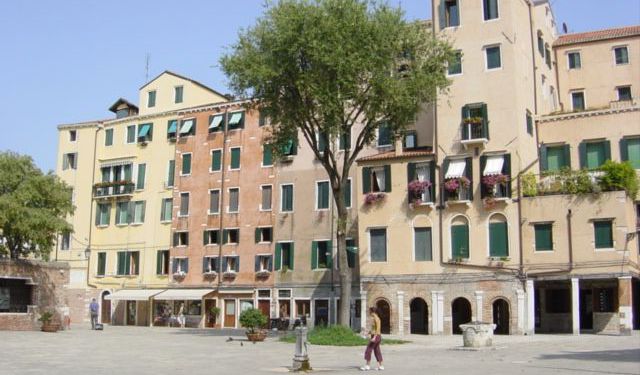
Founded in 1516, the Jewish Ghetto of Venice earns its grim little footnote in European history as the first place officially designated as a “ghetto.” It began as a Venetian compromise with sharp edges: the Papacy urged to expel the Jews, while Venice—never one to waste a useful population—chose to confine them to a small island.

The word “ghetto” comes with competing origin...  view more

Tour Duration: 1 Hour(s)
Travel Distance: 0.4 Km or 0.2 Miles
Murano Island Walking Tour

Murano Island Walking Tour

Murano Island is known around the world as the “Glass Island,” and it didn’t earn that nickname overnight. This reputation rests on more than seven centuries of uninterrupted glassmaking. Located just north of Venice, separated by a slim ribbon of lagoon water, Murano grew into a place where identity and industry became inseparable. Although inhabited since Roman times, the island truly...  view more

Tour Duration: 1 Hour(s)
Travel Distance: 2.3 Km or 1.4 Miles
Piazza San Marco Walking Tour

Piazza San Marco Walking Tour

Piazza San Marco is where Venice has always put on its best face. This is the city’s ceremonial and political core, shaped over centuries as the grand stage of the Venetian Republic. Its story began in the 9th century, when the relics of Saint Mark arrived in the lagoon and instantly raised the evangelist—much as the square built in his name—to the highest rank. From a simple open space, the...  view more

Tour Duration: 1 Hour(s)
Travel Distance: 0.6 Km or 0.4 Miles
Venice's Hidden Art Treasures

Venice's Hidden Art Treasures

Among the first things springing to mind when talking about Venice, apart from the canals and gondolas, of course, is Art and Architecture. Indeed, Venice is one of the few cities in the world where Art and Architecture have merged in a stunning multiplicity of forms. The city is even renowned for its unique (Venetian) pictorial school famed by the likes of Tintoretto, Titian, Veronese, Castagno...  view more

Tour Duration: 2 Hour(s)
Travel Distance: 3.6 Km or 2.2 Miles
Venice Introduction Walking Tour

Venice Introduction Walking Tour

Venice is a city that learned early how to live with water—and, ultimately, how to profit from it. Built across hundreds of small islands in a shallow lagoon in the northern Adriatic, it runs without roads, relying solely on canals and bridges. Although the lagoon itself formed thousands of years ago, it was inhabited mainly by fishermen up until the 5th century AD, when waves of barbarian...  view more

Tour Duration: 3 Hour(s)
Travel Distance: 4.1 Km or 2.5 Miles
Titian's Paintings Walk

Titian's Paintings Walk

One of the greatest painters of all time, Tiziano Vecelli – better known as Titian – was a pioneering figure of the Venetian school of Italian Renaissance painting. His career was successful from the start, and he became sought after by patrons, initially from Venice and its possessions, then joined by the north Italian princes, and finally the Habsburgs and papacy.

Equally adept with...  view more

Tour Duration: 2 Hour(s)
Travel Distance: 3.6 Km or 2.2 Miles
Useful Travel Guides for Planning Your Trip

15 Distinctively Italian Things to Buy in Venice

15 Distinctively Italian Things to Buy in Venice

Venice has been a tourist mecca for over a century now, with millions of visitors flocking in every year to see this unique place on the face of the Earth. Many, if not all, of these people seek to obtain something memorable as a token of their stay in this city. By far, not all of them know which...