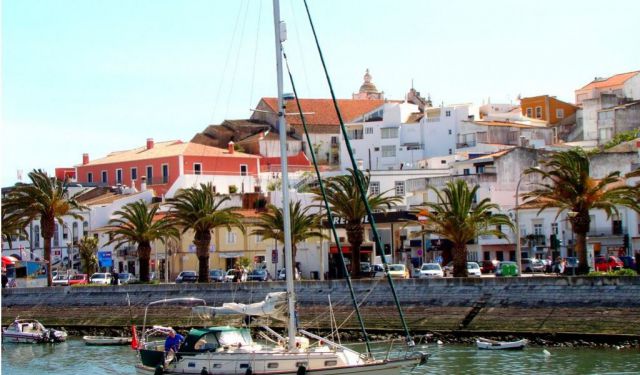


Lagos Coastline Walk, Lagos

Lagos Coastline Walk (Self Guided), Lagos

Characterful and charming as it is, the historic city of Lagos on the Algarve coast of Southern Portugal has not succumbed to mass tourism, fortunately, retaining much of its distinctive centuries-old heritage. Lagos’s extensive history is reflected in the varied attractions found throughout the city, such as the ancient Moorish city walls, 17th-century Forte da Ponta da Bandeira and cobbled streets, all contributing to the relaxed and welcoming atmosphere.

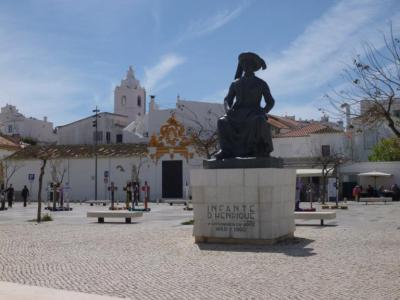
Indeed, there is a lot to see in Lagos, if only on a day trip. Henry the Navigator Statue, made by the famous national artist Leopoldo de Alemeida in 1960, and Castelo dos Governadores (Governors Castle), the ancient structure heavily damaged during the 1755 earthquake but still impressive, are to mention but a few.

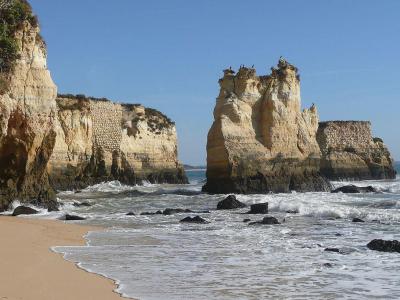
Still, the focal point of modern Lagos is its unique, almost 6.5-mile long coastline with little bays, four beautiful beaches, and impressive sand-colored cliffs. Just a leisurely walk away from the city center, this seafront area gives visitors an agony of choice between the multiple places to enjoy.

Prime among the fine beaches Lagos is blessed with is the vast sandy Meia Praia extending for 4 kilometers, neighboring the picturesque cove Praia Dona Ana and Praia do Camilo beaches secluded by golden-hued rock formations and lapped by crystal clear sea waters. Praia da Batata, although the closest beach from the town, is also one of its most crowded.

Further south of Lagos is the Ponta da Piedade headland, a paleontological treasure trove, with the hermitage of Nossa Senhora da Piedade dating from the 16th century.

To experience firsthand the scenic coastline and historic heritage of Lagos, take this self-guided walking tour and enjoy yourself.
How it works: Download the app "GPSmyCity: Walks in 1K+ Cities" from Apple App Store or Google Play Store to your mobile phone or tablet. The app turns your mobile device into a personal tour guide and its built-in GPS navigation functions guide you from one tour stop to next. The app works offline, so no data plan is needed when traveling abroad.

Download The GPSmyCity App

Lagos Coastline Walk Map

Guide Name: Lagos Coastline Walk
Guide Location: Portugal » Lagos (See other walking tours in Lagos)
Guide Type: Self-guided Walking Tour (Sightseeing)
# of Attractions: 8
Tour Duration: 2 Hour(s)
Travel Distance: 3.6 Km or 2.2 Miles
Author: AudreyB
Sight(s) Featured in This Guide:
  • Henry the Navigator Statue
  • Castelo dos Governadores (Governors' Castle)
  • Forte da Ponta da Bandeira (Flag's Mast Fort)
  • Praia da Batata (Batata Beach)
  • Praia do Pinhão (Pinhao Beach)
  • Praia Dona Ana (Dona Ana Beach)
  • Praia do Camilo (Camilo Beach)
  • Ponta da Piedade (Piety Point)
1
Henry the Navigator Statue

1) Henry the Navigator Statue

Starting with the nickname "The Navigator", much of the story of Infante Dom Henrique was myth and legend. Henry did have a strong interest on cosmography and he supported and launched maritime explorations of Africa but he stayed in Portugal.

Henrique is still in Portugal. He is celebrated with statues in several places in Portugal and in other countries. In Lagos, he sits in the main square of the town. He shares the square with the Old Slave Market (there is no new one) and with the Church of Santa Maria. The pedestal is inscribed "Infante D. Enrique", not "Navigator."

The statue was made by Leopoldo de Alemeida, a famous national artist, in 1960. Henrique is sitting. He stares rather vacantly into space. Perhaps, like Antonio in "The Merchant of Venice", he is worried about his rich argosies, dodging pirates on the high seas and crashing on a lee shore. Or perhaps he's planning his next venture abroad.
2
Castelo dos Governadores (Governors' Castle)

2) Castelo dos Governadores (Governors' Castle)

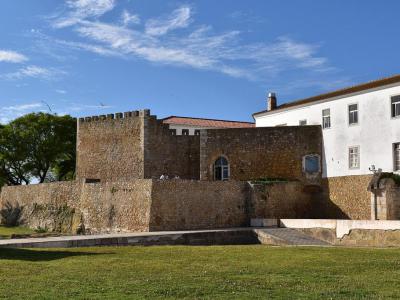
It is said the most interesting feature of the ancient walls of Lagos is the so-called Governors Castle. The Romans installed the first wall around the town. These walls were improved and strengthened by the successive Arab and Christian occupations. The walls were the primary defense against Barbary pirates and attacks by sea from Spain.

At the entrance of the Castle there are two free standing Arbello towers flanking the gateway to the town. They are connected to the wall but they stand forward a bit. This toughens the defenses at the gate and provides for flanking fire along the wall in conjunction with the nearby Flag's Mast Fort.

The castle was heavily damaged during the devastating earthquake of 1755 but it is still impressive. It is well known for its military style construction and the Manueline style window. It was at this window that King Sebastian said his final prayers before setting out for his disastrous defeat in the battle of Alcacer-Quibir.
3
Forte da Ponta da Bandeira (Flag's Mast Fort)

3) Forte da Ponta da Bandeira (Flag's Mast Fort) (must see)

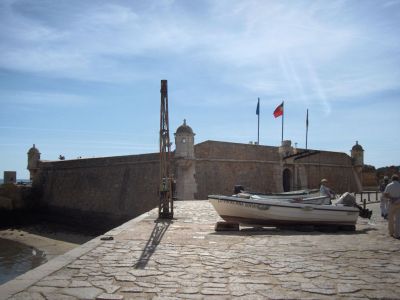
This is a fort with many names. It has been called (in Portuguese), Flag's Mast Fort, Our Lady of the Stone in France Fort, Registry Fort or the Fort of Lagos. We shall call it Flag's Mast Fort. It is a simple but effective fort with a lot of names.

It was built in the 17th century and positioned at the mouth of the Bensafirm River in full view of the sea. It was able to cover the docks and quays on the river banks and establish cross-fire with the redoubts of Lagos Castle and the city gates. When it was built it was considered to be one of the most effective defenses in the area.

It was planned with artillery in mind. It is square shaped with a moat and drawbridge. The walls are thick with sentry turrets at each corner. The Algarve coast was frequently the target of pirates and corsairs. Lagos at the time was the seat of the military government of the Algarve region. It was completed in 1690.

Inside there is a small chapel devoted to Santa Barbara, patron saint of armor makers, artillery soldiers and miners. The walls of the chapel are covered with blue azulejo tiles. The fort also holds a small museum with paintings and photographs on exhibit.
4
Praia da Batata (Batata Beach)

4) Praia da Batata (Batata Beach)

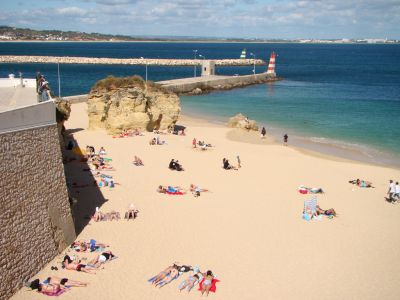
Batata Beach is one of the closest and most historically connected beaches to Lagos’ old town, located just beyond the city walls near the former harbour entrance. In earlier periods, its sheltered position made it a convenient landing place for small boats, fishermen, and coastal traffic, especially when access to the main harbour was limited or tightly controlled. During the medieval and early modern periods, the beach lay within direct sight of key fortifications, including the Governors’ Castle and Flag’s Mast Fort, which underlined its strategic importance.

After the earthquake and tsunami of 1755 reshaped the shoreline, the beach gradually lost its utilitarian role. By the 19th and 20th centuries, it was increasingly valued for its setting rather than its function.

The northern edge of the beach is divided by a long concrete pier, which originally formed the Solaria docks. While once part of the working waterfront, this area is now used for launching kayaks and small sailing boats heading along the coast toward nearby caves. Above the cliffs overlooking Batata Beach stands Mar restaurant, a popular option for a relaxed lunch, complemented by small, tasty offerings sold locally along the beach.

Today, Batata Beach is one of the most popular beaches in the city, particularly with families. Its proximity to the city centre, available amenities, and notably calm, still waters make it especially appealing. Lifeguards supervise the beach, and many locals are comfortable allowing their children to swim here unattended.
5
Praia do Pinhão (Pinhao Beach)

5) Praia do Pinhão (Pinhao Beach)

Pinhão Beach is a relatively small, sheltered cove tucked between limestone cliffs just east of Lagos’ historic centre, offering a noticeably quieter and more intimate alternative to nearby Batata Beach. Compared to its neighbour, Pinhão Beach feels calm and cosy.

For much of its history, Pinhão was used informally by locals. Its limited space and narrow access made it unsuitable for boats or large-scale activity, but ideal for bathing and quiet recreation as seaside leisure became more popular in the late 19th and early 20th centuries. Even today, the beach has relatively few facilities, a simplicity that adds to its charm.

Pinhão Beach consists of two distinct parts. The first is a small strip of sand directly below the access staircase, which is completely submerged at high tide. The second, on the other side of a rocky outcrop, is larger and features stones in the water that were placed there during the reconstruction of Praia da Dona Ana in 2015. A narrow tunnel carved through the rock connects the two sections, but it can only be used at low tide.

The sand is firmer and coarser than on other beaches, while the water is clear and suitable for swimming, though sometimes cool. During high tide, there is a spot on the left side popular for cliff jumping. Access is via a long staircase with terraced platforms built into the cliffs, and above it, a viewpoint offers sweeping coastal views—an ideal place to pause before descending to the sea.
6
Praia Dona Ana (Dona Ana Beach)

6) Praia Dona Ana (Dona Ana Beach)

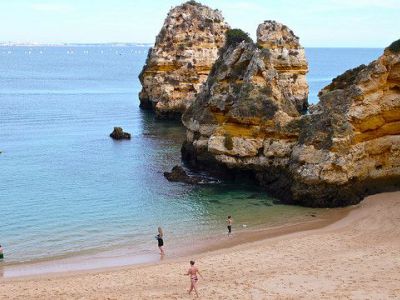
Dona Ana Beach is one of the most distinctive beaches along the Lagos coastline, set within a small bay framed by tall, eroded limestone cliffs. Unlike the harbour-facing beaches closer to the old town, Dona Ana lies along the open stretch of coast south of the historic walls. Historically, this area had little strategic or commercial use; the cliffs made access difficult, and the beach was never suited to boats or trade.

By the late 19th and early 20th centuries, Dona Ana began to attract local bathers, valued for its sheltered position and calm waters. Over time, it became one of the best-known beaches in Lagos, particularly as tourism expanded in the second half of the 20th century.

As you approach the beach from the road, a viewing platform offers excellent photo opportunities overlooking the beach and its clear waters. Facing the ocean, look toward the northern end of the viewing platform to spot the 93-step staircase that provides direct access to the shore.

Dona Ana is recognised for its dramatic scenery and relaxed atmosphere. Tall stacks and arches of golden rock rise directly from the sand and water, dividing the beach into smaller sections and offering shelter from sea breezes on blustery days. Alongside its natural setting, the beach provides the expected facilities of a popular destination, including nearby restaurants, small shops, and showers.

Dona Ana is best suited to sunbathing and swimming rather than energetic water sports. It does not attract jet skis, speedboats, or loud groups, contributing to its calm character. For visitors seeking peace and quiet in a visually striking coastal setting, Dona Ana offers an ideal place to spend a relaxed day by the sea.
7
Praia do Camilo (Camilo Beach)

7) Praia do Camilo (Camilo Beach)

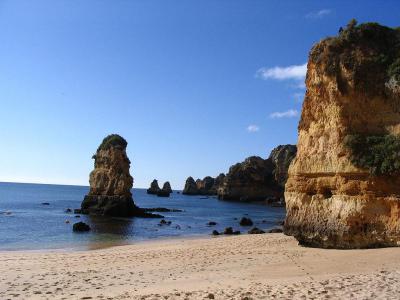
Camilo Beach is one of Lagos’ true coastal landmarks, set between two of the region’s most recognisable sites: Dona Ana Beach and Ponta da Piedade. It marks the last accessible beach along the Lagos coastline and is also one of the smallest beaches in the Algarve. Framed by steep limestone cliffs shaped by wind and sea, Camilo was never used for trade or defence.

For much of its history, Camilo remained a quiet stretch of coast known mainly to locals. That isolation helped preserve the rock formations that define it today. A distinctive tunnel carved through the rock connects two small sandy sections at low tide, while small caves tucked between the sand areas add to the sense of discovery.

From the clifftop, the view is among the most striking along the coast. Colourful rocks, caves, and open Atlantic water create a scene that draws photographers year-round. Reaching the beach requires descending a long wooden staircase of 224 well-maintained steps, which can feel endless from above but rewards each turn with new perspectives. The descent itself becomes part of the experience.

Camilo Beach can be visited throughout the year and is especially atmospheric in winter, when crowds thin and the landscape feels almost secluded. In summer, it is popular, but its small scale and lack of motorised water sports help maintain a relatively calm atmosphere. Facilities are minimal, with a small seasonal restaurant at the clifftop, allowing the setting itself to remain the main attraction.
8
Ponta da Piedade (Piety Point)

8) Ponta da Piedade (Piety Point) (must see)

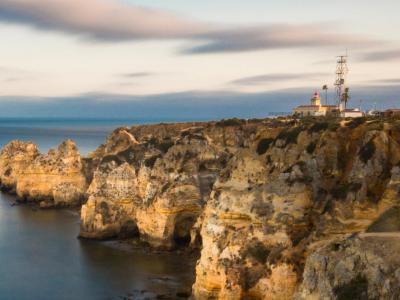
Piety Point marks the southern edge of Lagos’ coastline and is one of the Algarve’s most recognisable natural landmarks. Its origins lie in a geological accident that occurred millions of years ago during the Miocene period, when tectonic movement and changing sea levels exposed a limestone promontory to erosion. As the waters gradually receded, wind and waves carved the newly revealed rock into the dramatic cliffs, arches, stacks, and grottos visible today, rising in places to around 115 feet (or 35 metres) above the sea.

The headland is a true geological and palaeontological archive. Fossils of ancient corals and marine life, including shark teeth, have been found embedded in the rock. For early Mediterranean cultures, the sea was often regarded as divine, and Piety Point came to be viewed as a place of special significance. Bronze Age artefacts continue to be recovered on land, alongside underwater traces of Roman presence in the form of coins and submerged remains.

Its prominence did not escape military attention. The cape’s height and clear views made it a natural surveillance point over approaches from the sea. A military battery was installed here in 1663 and remained in use until 1821, after the Napoleonic period had come to an end.

Today, Piety Point is revered by locals and admired by visitors. The cliffs are riddled with caves that can be explored on foot via stairways carved into the rock near the lighthouse, or from the water by boat or kayak. One such access route is a steep limestone staircase of 182 steps, descending into a sheltered cove. At the bottom, you reach sea level, where small boats often wait to take visitors into the labyrinth of grottos and sea arches. The staircase is easily found by walking away from the lighthouse in a south-easterly direction. Alternatively, boat excursions depart regularly from Lagos Marina.

From the clifftop paths, visitors encounter uninterrupted Atlantic views and a landscape shaped entirely by time, water, and stone. These paths begin as wooden boardwalks and can be found by turning right from the main road before entering the lighthouse grounds.

In 2015, The Huffington Post named Piety Point its favourite beach destination worldwide, citing its extraordinary natural beauty.

Walking Tours in Lagos, Portugal

Create Your Own Walk in Lagos

Create Your Own Walk in Lagos

Creating your own self-guided walk in Lagos is easy and fun. Choose the city attractions that you want to see and a walk route map will be created just for you. You can even set your hotel as the start point of the walk.
Lagos Introduction Walking Tour

Lagos Introduction Walking Tour

Lagos, from captive to captivating.

The story of Lagos is over 2,000 years old. It was a Celtic settlement before the Punic Wars of Rome and Carthage. During the Second Punic War the people of Lagos sided with Hannibal and the Carthaginians. That didn't work out so well. The Romans came, then the Visigoths from Toledo, followed by the Byzantines. In the 8th century the Moors arrived.

...  view more

Tour Duration: 2 Hour(s)
Travel Distance: 2.6 Km or 1.6 Miles