

Yekaterinburg Introduction Walking Tour (Self Guided), Yekaterinburg
Yekaterinburg is the fourth largest city in the Russian Federation based on population and is a major center of industrial and cultural life in the Urals. Situated near the center of the Eurasian continent, on the border between Europe and Asia, the city is home to many spectacular sights, which you will see on this tour. Don't miss the chance to visit Yekaterinburg and enjoy an unforgettable experience.
How it works: Download the app "GPSmyCity: Walks in 1K+ Cities" from Apple App Store or Google Play Store to your mobile phone or tablet. The app turns your mobile device into a personal tour guide and its built-in GPS navigation functions guide you from one tour stop to next. The app works offline, so no data plan is needed when traveling abroad.
Yekaterinburg Introduction Walking Tour Map
Guide Name: Yekaterinburg Introduction Walking Tour
Guide Location: Russia » Yekaterinburg (See other walking tours in Yekaterinburg)
Guide Type: Self-guided Walking Tour (Sightseeing)
# of Attractions: 14
Tour Duration: 3 Hour(s)
Travel Distance: 4.7 Km or 2.9 Miles
Author: damon
Sight(s) Featured in This Guide:
Guide Location: Russia » Yekaterinburg (See other walking tours in Yekaterinburg)
Guide Type: Self-guided Walking Tour (Sightseeing)
# of Attractions: 14
Tour Duration: 3 Hour(s)
Travel Distance: 4.7 Km or 2.9 Miles
Author: damon
Sight(s) Featured in This Guide:
- Square of 1905
- Yekaterinburg City Administration
- City Dam
- Yekaterinburg Fine Arts Museum
- Keyboard Monument
- State Stone Cutting and Jewelers Art History Museum
- State Academic Philharmonic
- Church of All Saints
- Rastorguyev-Kharitonov Palace
- Church of Ascension
- Black Tulip Memorial
- Ural State University
- Statue of Yakov Sverdlov
- Opera and Ballet Theater
1) Square of 1905
Square of 1905 is the main civic space of the city. Its history goes back more than two hundred years. It first developed as a trading ground and later became an administrative center as the settlement grew. The current name refers to the 1905 Russian Revolution, a time of strikes and protests that affected many industrial regions.
The buildings around the square come from different periods, but the space is visually focused on the monument to Vladimir Lenin. The statue was installed in 1957 and stands at the center of the open area. The wide rectangular layout of the square was planned to frame the monument and allow large public gatherings. Because of this, the statue has long been used as a meeting point and a place of orientation.
In winter, the square changes into a large ice town. Temporary structures made of ice and snow appear every year, including sculptures, slides, lit passages, and a tall New Year tree. During the holidays, fairground rides and seasonal stalls operate nearby, making the square a popular place for evening walks. On May 9, the square hosts Victory Day events, including a military parade and official ceremonies. On regular days, it serves as a transit and meeting space, used daily by residents.
The buildings around the square come from different periods, but the space is visually focused on the monument to Vladimir Lenin. The statue was installed in 1957 and stands at the center of the open area. The wide rectangular layout of the square was planned to frame the monument and allow large public gatherings. Because of this, the statue has long been used as a meeting point and a place of orientation.
In winter, the square changes into a large ice town. Temporary structures made of ice and snow appear every year, including sculptures, slides, lit passages, and a tall New Year tree. During the holidays, fairground rides and seasonal stalls operate nearby, making the square a popular place for evening walks. On May 9, the square hosts Victory Day events, including a military parade and official ceremonies. On regular days, it serves as a transit and meeting space, used daily by residents.
2) Yekaterinburg City Administration
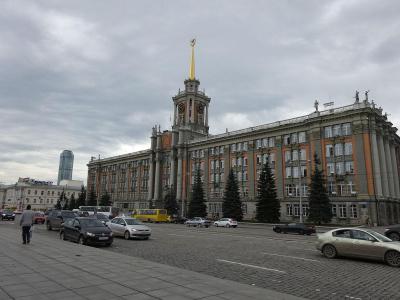
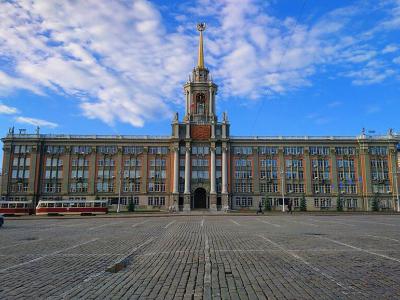
The Yekaterinburg City Administration building shows several stages of the city’s growth rather than one fixed style. The site first held a Merchant Hall in the 19th century and was later adapted for city authorities in the early Soviet period. Over time, it expanded into a large civic building, combining its commercial past with Soviet additions and postwar changes. These layers clearly show how political needs shaped the city’s main public space.
The building took on its present form during a major reconstruction between 1944 and the early 1950s. The earlier constructivist structure was rebuilt in the Stalinist Neoclassical style, with an emphasis on scale and symmetry. It still serves as the city’s main administrative building and is often seen as a visual symbol of Yekaterinburg as the “Capital of the Urals.”
A key feature of the complex is the central clock tower, completed in 1954 and designed by Moisei Reisher. It rises above the main building and is marked by large clock faces and a slim spire with a red Soviet star. The tower changed the city skyline and made the building an easy landmark in the civic center. Although the building is still used for city administration, its exterior continues to reflect the ideas of authority and order typical of the postwar Soviet period.
The building took on its present form during a major reconstruction between 1944 and the early 1950s. The earlier constructivist structure was rebuilt in the Stalinist Neoclassical style, with an emphasis on scale and symmetry. It still serves as the city’s main administrative building and is often seen as a visual symbol of Yekaterinburg as the “Capital of the Urals.”
A key feature of the complex is the central clock tower, completed in 1954 and designed by Moisei Reisher. It rises above the main building and is marked by large clock faces and a slim spire with a red Soviet star. The tower changed the city skyline and made the building an easy landmark in the civic center. Although the building is still used for city administration, its exterior continues to reflect the ideas of authority and order typical of the postwar Soviet period.
3) City Dam (must see)
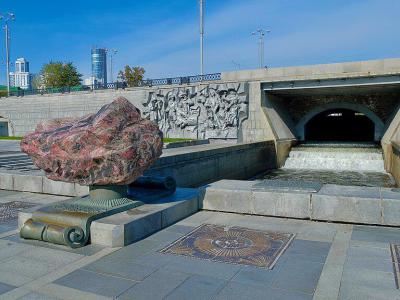
The City Dam marks the place where the city first began to develop in the early 18th century. Built across the Iset River, it originally supplied water power for the first ironworks in the Urals. The earliest dam was a simple timber-and-earth structure, designed only for practical use. As the factory settlement grew, the dam was reinforced and later rebuilt in stone, becoming a permanent feature of the urban landscape.
By the late 19th century, heavy industry had moved to other areas, and the dam slowly lost its industrial role. It remained an important crossing point and a familiar landmark, but it was no longer used for production. During the Soviet period, the area around the dam was redesigned with embankments, steps, and open paved spaces. The focus shifted to public use, and the site became linked to walking, meetings, and public events rather than work.
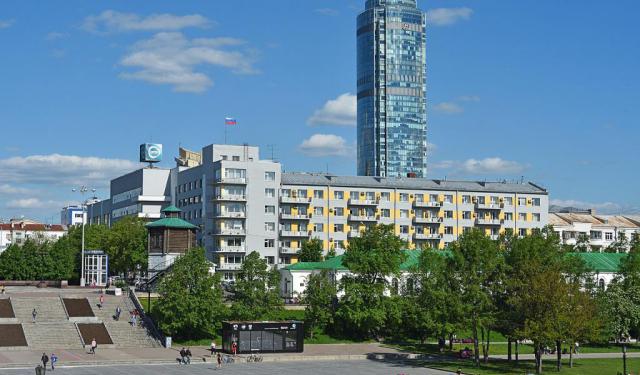
Today, the City Dam is part of a pedestrian zone connecting the riverbanks, nearby squares, and cultural buildings. People walk along the promenade, stop to watch the water flowing over the dam, or sit by the pond. The space is often used for meeting friends, taking photos, and watching how the area changes with the seasons. Small sculptures, memorials, and temporary installations add interest without overwhelming the space.
The dam is also a regular place for outdoor events. Festivals, concerts, and public celebrations are held nearby, especially in warmer months. In winter, the frozen pond and snow-covered embankments attract walkers and photographers. The City Dam continues to serve everyday city life while remaining closely linked to the area’s earliest history.
By the late 19th century, heavy industry had moved to other areas, and the dam slowly lost its industrial role. It remained an important crossing point and a familiar landmark, but it was no longer used for production. During the Soviet period, the area around the dam was redesigned with embankments, steps, and open paved spaces. The focus shifted to public use, and the site became linked to walking, meetings, and public events rather than work.
Today, the City Dam is part of a pedestrian zone connecting the riverbanks, nearby squares, and cultural buildings. People walk along the promenade, stop to watch the water flowing over the dam, or sit by the pond. The space is often used for meeting friends, taking photos, and watching how the area changes with the seasons. Small sculptures, memorials, and temporary installations add interest without overwhelming the space.
The dam is also a regular place for outdoor events. Festivals, concerts, and public celebrations are held nearby, especially in warmer months. In winter, the frozen pond and snow-covered embankments attract walkers and photographers. The City Dam continues to serve everyday city life while remaining closely linked to the area’s earliest history.
4) Yekaterinburg Fine Arts Museum (must see)
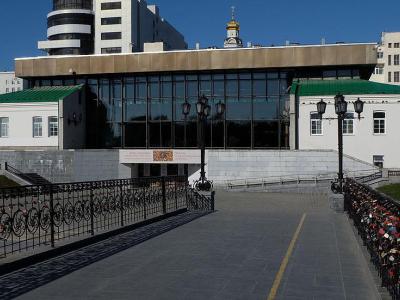
The Yekaterinburg Fine Arts Museum is one of the main public art museums in the Ural region. It opened in 1936, during a period when regional museums were being created to support education and wider access to culture. The collection was formed through state transfers and local sources, bringing together works from different periods of Russian art. Today, the museum is spread across several historic buildings, with each one focused on a specific part of the collection.
One of the most well-known sections is dedicated to Kasli cast iron art, a craft closely linked to Ural industry. The displays include decorative objects, sculptures, and architectural details made in the 19th and early 20th centuries. The main centerpiece is the large cast iron pavilion created for the 1900 Paris World Exhibition. It is made up of hundreds of detailed elements and shows how industrial materials were used not only for practical purposes, but also for complex artistic design.
Another major part of the museum is the collection of Russian icon painting, dating from the 16th to the early 20th century. The icons are arranged in chronological order, making it easy to see how styles, colors, and compositions changed over time. Nearby galleries present Russian painting from the 18th and 19th centuries, including portraits, historical scenes, and landscapes. These works reflect academic traditions and careful attention to form and detail.
The final section focuses on modern and 20th-century art. Paintings, graphic works, and sculpture explore themes of social change, industrial development, and everyday life. Temporary exhibitions, lectures, and guided tours help connect the permanent collection with newer artistic ideas and provide additional context for visitors.
One of the most well-known sections is dedicated to Kasli cast iron art, a craft closely linked to Ural industry. The displays include decorative objects, sculptures, and architectural details made in the 19th and early 20th centuries. The main centerpiece is the large cast iron pavilion created for the 1900 Paris World Exhibition. It is made up of hundreds of detailed elements and shows how industrial materials were used not only for practical purposes, but also for complex artistic design.
Another major part of the museum is the collection of Russian icon painting, dating from the 16th to the early 20th century. The icons are arranged in chronological order, making it easy to see how styles, colors, and compositions changed over time. Nearby galleries present Russian painting from the 18th and 19th centuries, including portraits, historical scenes, and landscapes. These works reflect academic traditions and careful attention to form and detail.
The final section focuses on modern and 20th-century art. Paintings, graphic works, and sculpture explore themes of social change, industrial development, and everyday life. Temporary exhibitions, lectures, and guided tours help connect the permanent collection with newer artistic ideas and provide additional context for visitors.
5) Keyboard Monument (must see)
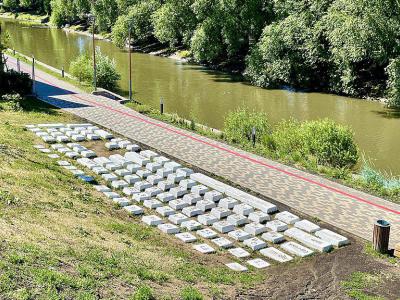
The Keyboard Monument is an outdoor artwork created in 2005 by artist Anatoly Vyatkin. It shows a full QWERTY keyboard made at a much larger scale and placed directly on the ground. Each key is cast in concrete and set in the same order as on a real computer keyboard, so letters, numbers, and symbols are easy to recognise. The idea comes from the early 21st century, when computers became part of everyday work, communication, and free time.
The keys are big enough for people to sit, stand, or walk on, so the monument can be used, not only viewed. The layout includes number keys and special symbols, just like a standard keyboard. The sculpture plays on the contrast between heavy concrete and digital information, which is usually fast and invisible, turning a small personal object into a shared outdoor space. Over time, it has become part of daily life: people walk across the keys, spell words with their steps, or meet friends there. With no fences or rules, it blends easily into everyday routines, and its clear, familiar shape makes it a popular subject for photos and online searches.
By 2026, the monument shows clear signs of age. Reports from 2024 and 2025 mention surface damage and worn concrete, pointing to the need for restoration. In the past, it also suffered from neglect and vandalism. Several keys, including F1, F2, F3, and Y, were once stolen but later replaced thanks to local volunteers. Despite these problems, the monument continues to draw attention and remains one of the most searched public artworks in the country.
The keys are big enough for people to sit, stand, or walk on, so the monument can be used, not only viewed. The layout includes number keys and special symbols, just like a standard keyboard. The sculpture plays on the contrast between heavy concrete and digital information, which is usually fast and invisible, turning a small personal object into a shared outdoor space. Over time, it has become part of daily life: people walk across the keys, spell words with their steps, or meet friends there. With no fences or rules, it blends easily into everyday routines, and its clear, familiar shape makes it a popular subject for photos and online searches.
By 2026, the monument shows clear signs of age. Reports from 2024 and 2025 mention surface damage and worn concrete, pointing to the need for restoration. In the past, it also suffered from neglect and vandalism. Several keys, including F1, F2, F3, and Y, were once stolen but later replaced thanks to local volunteers. Despite these problems, the monument continues to draw attention and remains one of the most searched public artworks in the country.
6) State Stone Cutting and Jewelers Art History Museum (must see)
Founded in 1992, the State Stone Cutting and Jewelers Art History Museum focuses on stone cutting and jewelry art. It is housed in a former pharmaceutical building from the early 19th century. The building has a simple Classical design, which contrasts with the bright colors and complex surfaces of the stone and metal objects inside. Today, the museum works as both an exhibition space and a research center dedicated to applied arts based on Ural mineral resources.
A major part of the collection comes from the Imperial Lapidary Works and shows state-supported stone cutting of the 18th and 19th centuries. One of the most important pieces is a vase made of Kalkan jasper, about 1.5 meters high. It is among the oldest and largest surviving stone-cut works in the region.
Another section focuses on stories connected to stone and local culture. Eleven decorative panels are based on Ural folk tales recorded by Pavel Bazhov in The Malachite Casket. These panels show figures such as the Mistress of the Copper Mountain and are created using stone, metal, and mixed techniques. This display explains how folklore shaped artistic images and gave minerals symbolic meaning in the region.
In addition to its permanent collection, the museum regularly hosts temporary exhibitions, lectures, and workshops. Contemporary jewelers and stone cutters take part, showing how traditional materials and skills are used in modern work. This mix of historical objects and current practice shapes the museum’s activity today.
A major part of the collection comes from the Imperial Lapidary Works and shows state-supported stone cutting of the 18th and 19th centuries. One of the most important pieces is a vase made of Kalkan jasper, about 1.5 meters high. It is among the oldest and largest surviving stone-cut works in the region.
Another section focuses on stories connected to stone and local culture. Eleven decorative panels are based on Ural folk tales recorded by Pavel Bazhov in The Malachite Casket. These panels show figures such as the Mistress of the Copper Mountain and are created using stone, metal, and mixed techniques. This display explains how folklore shaped artistic images and gave minerals symbolic meaning in the region.
In addition to its permanent collection, the museum regularly hosts temporary exhibitions, lectures, and workshops. Contemporary jewelers and stone cutters take part, showing how traditional materials and skills are used in modern work. This mix of historical objects and current practice shapes the museum’s activity today.
7) State Academic Philharmonic (must see)
Sverdlovsk State Academic Philharmonic was founded in 1936 to develop professional classical music in the Ural region. It grew out of the Sverdlovsk Radio Committee Orchestra and introduced a regular system of symphonic and chamber concerts. From its early years, it became the main center for academic music in the region, combining performances with education and outreach.
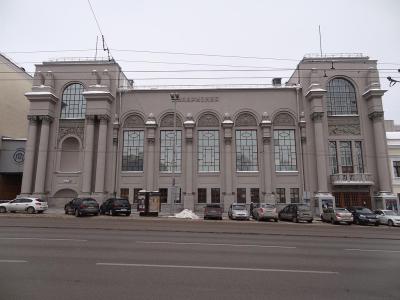
The main concert hall occupies a building constructed in 1915–1917 as the Civic Assembly Building. It was originally intended as a club for merchants and industrialists and was later adapted for concert use, keeping its role as a public cultural space.
The Philharmonic is home to several permanent ensembles, including the Ural Philharmonic Orchestra, the Yekaterinburg Philharmonic Choir, and the Ural Youth Symphony Orchestra. Their repertoire includes works by composers such as Beethoven and Tchaikovsky, as well as music of the 20th and 21st centuries, with regular commissions and attention to contemporary composers.
Today, the Philharmonic presents concerts throughout the year and reaches remote audiences through its Digital Concert Hall, which broadcasts live performances across the Sverdlovsk region. It hosts major events such as the Eurasian Music Festival and the Russian edition of La Folle Journée, while educational programs, including the Sverdlovsk State Children’s Philharmonic Society, introduce classical music to students and new listeners. From 2018 to 2025, the institution has also been linked to an expansion project by Zaha Hadid Architects, planning a new concert hall next to the historic building.
The main concert hall occupies a building constructed in 1915–1917 as the Civic Assembly Building. It was originally intended as a club for merchants and industrialists and was later adapted for concert use, keeping its role as a public cultural space.
The Philharmonic is home to several permanent ensembles, including the Ural Philharmonic Orchestra, the Yekaterinburg Philharmonic Choir, and the Ural Youth Symphony Orchestra. Their repertoire includes works by composers such as Beethoven and Tchaikovsky, as well as music of the 20th and 21st centuries, with regular commissions and attention to contemporary composers.
Today, the Philharmonic presents concerts throughout the year and reaches remote audiences through its Digital Concert Hall, which broadcasts live performances across the Sverdlovsk region. It hosts major events such as the Eurasian Music Festival and the Russian edition of La Folle Journée, while educational programs, including the Sverdlovsk State Children’s Philharmonic Society, introduce classical music to students and new listeners. From 2018 to 2025, the institution has also been linked to an expansion project by Zaha Hadid Architects, planning a new concert hall next to the historic building.
8) Church of All Saints (must see)
The Church of All Saints was built as a memorial on the site of the former Ipatiev House, where Emperor Nicholas II and his family were executed in July 1918. During the Soviet period, the house was demolished, and the topic was not openly discussed for many years. The church was consecrated in 2003, after the Romanov family was canonized. Today it works both as a functioning Orthodox church and as a place connected to this key moment in Russian history.
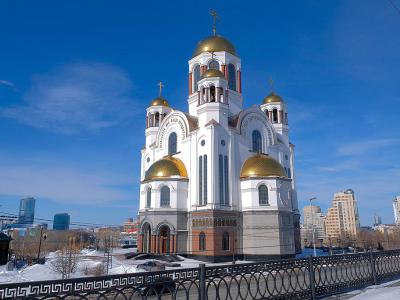
The building is designed in the Russian Revival style. It has white walls, gilded domes, and a tall structure built in clear vertical levels. A staircase of 23 steps links the lower and upper churches. The number refers to the 23 years of Nicholas II’s reign, from 1894 to 1917, and also recalls the steps the imperial family walked down to the basement of the Ipatiev House. The main altar stands directly above the place identified as the execution site.
Inside, the church is filled with icons and memorial objects. Among the most important are relics connected to the imperial family, including a tooth attributed to Tsarevich Alexei, as well as relics of Saint Seraphim of Sarov. The interior also contains the “Three-Handed” Mother of God icon, believed to have belonged to the Romanovs and to have been with them during their last days.
The church plays an active role in public remembrance. Every year, during the night of July 16–17, it serves as the starting point for a large cross procession to the Ganina Yama Monastery. The surrounding grounds continue to change, and in 2025 a new monument was added that introduces modern military themes, showing how ideas of memory and commemoration around the site continue to evolve.
The building is designed in the Russian Revival style. It has white walls, gilded domes, and a tall structure built in clear vertical levels. A staircase of 23 steps links the lower and upper churches. The number refers to the 23 years of Nicholas II’s reign, from 1894 to 1917, and also recalls the steps the imperial family walked down to the basement of the Ipatiev House. The main altar stands directly above the place identified as the execution site.
Inside, the church is filled with icons and memorial objects. Among the most important are relics connected to the imperial family, including a tooth attributed to Tsarevich Alexei, as well as relics of Saint Seraphim of Sarov. The interior also contains the “Three-Handed” Mother of God icon, believed to have belonged to the Romanovs and to have been with them during their last days.
The church plays an active role in public remembrance. Every year, during the night of July 16–17, it serves as the starting point for a large cross procession to the Ganina Yama Monastery. The surrounding grounds continue to change, and in 2025 a new monument was added that introduces modern military themes, showing how ideas of memory and commemoration around the site continue to evolve.
9) Rastorguyev-Kharitonov Palace (must see)
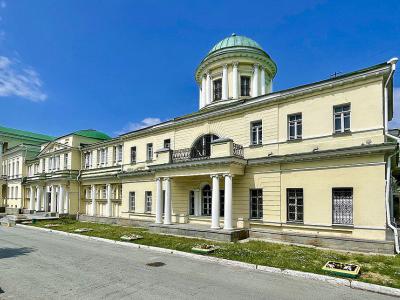
Rastorguyev-Kharitonov Palace is one of the largest surviving private noble estates from the early 19th century in the Urals. Construction began in the 1790s and continued for several decades, as the owners and their plans changed. The palace is named after merchant Lev Rastorguyev and his son-in-law Pyotr Kharitonov, who expanded the estate and shaped its final appearance. It was built both as a family residence and as a clear sign of wealth and social standing.
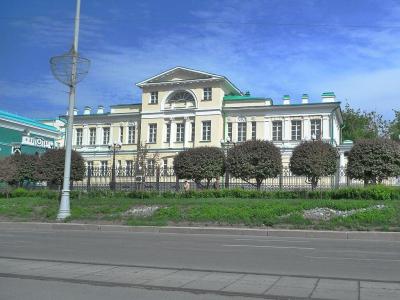
The main building follows the rules of Russian Classicism. The façade is symmetrical and organized around a central portico with tall columns. Side wings and strict proportions give the building a balanced and orderly look. The walls are light in color, with darker details that highlight the structure. Decoration is limited, so the focus stays on size, shape, and rhythm rather than rich ornament.
Behind the palace lies a large landscaped garden designed in the English style. Curved paths, open grassy areas, and old trees create a softer space that contrasts with the strict palace façade. Artificial hills, small bridges, and ponds were added to make walks more varied and visually interesting. Some parts of the garden still show traces of older buildings and service areas, reminding visitors that the estate once worked as a self-contained complex.
Over time, the palace was used for different purposes, including administrative and educational functions. Today, access to the interiors is limited, but the exterior and the park remain open. Together, they help show how wealthy merchant families lived and how they chose to present themselves in the late imperial period.
The main building follows the rules of Russian Classicism. The façade is symmetrical and organized around a central portico with tall columns. Side wings and strict proportions give the building a balanced and orderly look. The walls are light in color, with darker details that highlight the structure. Decoration is limited, so the focus stays on size, shape, and rhythm rather than rich ornament.
Behind the palace lies a large landscaped garden designed in the English style. Curved paths, open grassy areas, and old trees create a softer space that contrasts with the strict palace façade. Artificial hills, small bridges, and ponds were added to make walks more varied and visually interesting. Some parts of the garden still show traces of older buildings and service areas, reminding visitors that the estate once worked as a self-contained complex.
Over time, the palace was used for different purposes, including administrative and educational functions. Today, access to the interiors is limited, but the exterior and the park remain open. Together, they help show how wealthy merchant families lived and how they chose to present themselves in the late imperial period.
10) Church of Ascension (must see)
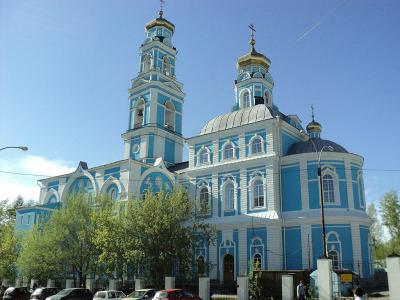
The Church of Ascension began in May 1770 as a small wooden parish church. It served an Orthodox community that was still forming at the time. As the number of parishioners grew and life became more settled, the wooden building was no longer enough. This followed a common path in Russian church history, where early wooden churches were later replaced with stone ones meant to last much longer.
Work on the present stone church started in 1792 and finished in 1818. The building has two levels, each with its own dedication. The lower church is devoted to the Nativity of the Blessed Virgin Mary, while the upper church is dedicated to the Ascension of the Lord. This layout made it possible to use different spaces at different times of the year. Architecturally, the church stands between late Baroque and early Classical styles, with clear shapes and balanced proportions instead of heavy decoration.
Inside, the space feels calm and orderly. Both levels have their own iconostasis, arranged in the traditional Orthodox way and drawing attention toward the altar. Many icons and church furnishings date back to the 19th century, reflecting local religious art and long-standing worship practices. Tall windows let in soft light, and the restrained colours support a quiet, reflective mood.
The church was closed in 1926 during the Soviet period. Over the following decades, it was used first as a school and later as a Museum of Local History. In 1991, the building was returned to the parish, and services resumed. Since then, it has continued to function as an active church, shaped by more than two centuries of religious, social, and architectural change.
Work on the present stone church started in 1792 and finished in 1818. The building has two levels, each with its own dedication. The lower church is devoted to the Nativity of the Blessed Virgin Mary, while the upper church is dedicated to the Ascension of the Lord. This layout made it possible to use different spaces at different times of the year. Architecturally, the church stands between late Baroque and early Classical styles, with clear shapes and balanced proportions instead of heavy decoration.
Inside, the space feels calm and orderly. Both levels have their own iconostasis, arranged in the traditional Orthodox way and drawing attention toward the altar. Many icons and church furnishings date back to the 19th century, reflecting local religious art and long-standing worship practices. Tall windows let in soft light, and the restrained colours support a quiet, reflective mood.
The church was closed in 1926 during the Soviet period. Over the following decades, it was used first as a school and later as a Museum of Local History. In 1991, the building was returned to the parish, and services resumed. Since then, it has continued to function as an active church, shaped by more than two centuries of religious, social, and architectural change.
11) Black Tulip Memorial (must see)
The Black Tulip Memorial commemorates soldiers who died in the Soviet war in Afghanistan and in later military conflicts. It was inaugurated on August 5, 1995, at a time when public discussion of these wars was becoming more open. The memorial avoids references to battles or victories and instead focuses on loss, absence, and the return of those who did not come back alive. Its theme reflects a shift from official military narratives toward personal memory.
The name “Black Tulip” refers to the Antonov An-12 military transport aircraft used to repatriate the bodies of fallen soldiers, officially recorded as “Cargo 200.” For families and veterans, the aircraft became a lasting symbol of grief and final journeys home. The term entered wider public awareness through a well-known song by Alexander Rosenbaum, which helped fix the image of the Black Tulip in cultural memory and public language.
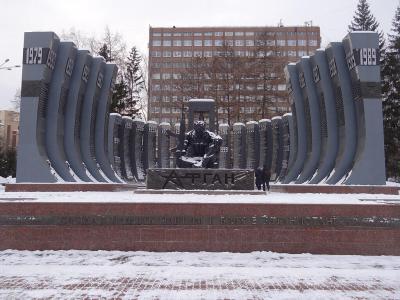
The artistic design centres on a 4.7-metre-tall bronze soldier sitting with his head lowered and a rifle across his knees. The pose suggests tiredness and grief rather than victory. Around him stand metal pylons about 10 metres high, shaped like the inside of an An-12 aircraft. They can also be seen as wings or flower petals, forming a closed space around the figure. Nearby plaques list the names of the fallen. Visitors often stop to read them or leave flowers, and the memorial remains a quiet place for reflection.
The name “Black Tulip” refers to the Antonov An-12 military transport aircraft used to repatriate the bodies of fallen soldiers, officially recorded as “Cargo 200.” For families and veterans, the aircraft became a lasting symbol of grief and final journeys home. The term entered wider public awareness through a well-known song by Alexander Rosenbaum, which helped fix the image of the Black Tulip in cultural memory and public language.
The artistic design centres on a 4.7-metre-tall bronze soldier sitting with his head lowered and a rifle across his knees. The pose suggests tiredness and grief rather than victory. Around him stand metal pylons about 10 metres high, shaped like the inside of an An-12 aircraft. They can also be seen as wings or flower petals, forming a closed space around the figure. Nearby plaques list the names of the fallen. Visitors often stop to read them or leave flowers, and the memorial remains a quiet place for reflection.
12) Ural State University
Ural State University was founded in 1920 and became one of the first large universities in the Ural region. It grew during a time of rapid industrial and scientific development and trained specialists in engineering, natural sciences, humanities, and public service. Many graduates later worked in research, education, and government, both in the region and across the country.
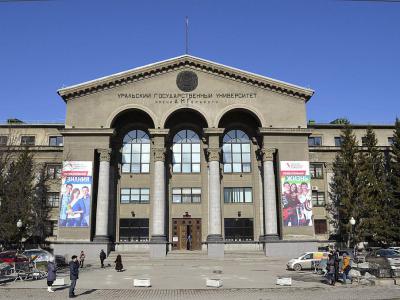
The campus reflects different periods of 20th-century architecture. Early Soviet buildings were designed to be practical and large, while later, after the war, new buildings added more classrooms and laboratories. The exteriors are simple and geometric. Inside, the spaces follow a familiar university layout with lecture halls, corridors, labs, and reading rooms. In some buildings, original interior details from the time of construction are still visible.
Today, the former Ural State University is part of a federal university but continues to follow its own academic traditions. In the 2026 academic year, it was ranked #519 in the QS World University Rankings. The university is ranked in the global top 100 in fields including Petroleum Engineering, Social Policy and Administration, and Hospitality and Leisure Management. In 2025, it ranked second in Russia for patent activity, and twenty research teams received major grants from the Russian Science Foundation, covering topics from space science to neurocognitive research.
The campus reflects different periods of 20th-century architecture. Early Soviet buildings were designed to be practical and large, while later, after the war, new buildings added more classrooms and laboratories. The exteriors are simple and geometric. Inside, the spaces follow a familiar university layout with lecture halls, corridors, labs, and reading rooms. In some buildings, original interior details from the time of construction are still visible.
Today, the former Ural State University is part of a federal university but continues to follow its own academic traditions. In the 2026 academic year, it was ranked #519 in the QS World University Rankings. The university is ranked in the global top 100 in fields including Petroleum Engineering, Social Policy and Administration, and Hospitality and Leisure Management. In 2025, it ranked second in Russia for patent activity, and twenty research teams received major grants from the Russian Science Foundation, covering topics from space science to neurocognitive research.
13) Statue of Yakov Sverdlov (must see)
The statue of Yakov Sverdlov is an early Soviet monument created after the 1917 Revolution, when public space was reshaped to reflect the new political system. Sverdlov was a key organizer of Bolshevik power and served as Chairman of the All-Russian Central Executive Committee, acting as head of state. After his death in 1919, monuments to him were used to embed revolutionary history in the urban landscape.
Plans for the monument were developed in the mid-1920s, during the period of monumental propaganda, when sculpture served political education. The statue was unveiled in 1927 for the tenth anniversary of the October Revolution. It was created by sculptor Matvey Kharlamov with architectural design by Sigismund Dombrovsky. The pedestal inscription, “To Yakov Mikhailovich Sverdlov (comrade Andrey) from Ural workers,” emphasizes the official link between revolutionary leaders and industrial workers.
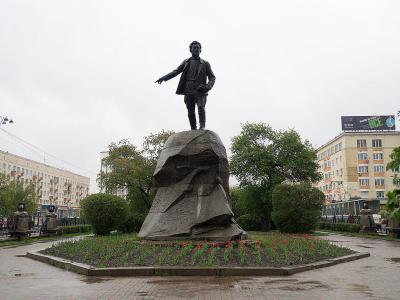
The bronze figure stands on a rough granite boulder instead of a traditional pedestal. Sverdlov’s right arm is stretched forward in a firm, directing gesture, while his left hand holds a cap. The uneven stone base and the active pose create a sense of movement and urgency. This approach reflects the experimental style of early Soviet monuments and differs from the more rigid statues that became common later.
Today, the monument is often viewed with more mixed feelings. Alongside Sverdlov’s role as a revolutionary leader, historians point to his involvement in decisions linked to the execution of Nicholas II and the Romanov family in 1918. Because of this, the statue is no longer seen only as a tribute, but also as a reminder of the difficult and often violent realities of the revolutionary period.
Plans for the monument were developed in the mid-1920s, during the period of monumental propaganda, when sculpture served political education. The statue was unveiled in 1927 for the tenth anniversary of the October Revolution. It was created by sculptor Matvey Kharlamov with architectural design by Sigismund Dombrovsky. The pedestal inscription, “To Yakov Mikhailovich Sverdlov (comrade Andrey) from Ural workers,” emphasizes the official link between revolutionary leaders and industrial workers.
The bronze figure stands on a rough granite boulder instead of a traditional pedestal. Sverdlov’s right arm is stretched forward in a firm, directing gesture, while his left hand holds a cap. The uneven stone base and the active pose create a sense of movement and urgency. This approach reflects the experimental style of early Soviet monuments and differs from the more rigid statues that became common later.
Today, the monument is often viewed with more mixed feelings. Alongside Sverdlov’s role as a revolutionary leader, historians point to his involvement in decisions linked to the execution of Nicholas II and the Romanov family in 1918. Because of this, the statue is no longer seen only as a tribute, but also as a reminder of the difficult and often violent realities of the revolutionary period.
14) Opera and Ballet Theater (must see)
The Ural Opera Ballet opened in 1912 and has played an important role in professional music and stage art in the Ural region. The theater stayed open during wars and political changes, keeping performances going without long breaks. Its stage was an early workplace for major artists, including Sergei Lemeshev and Irina Arkhipova, who appeared here at the beginning of their careers.
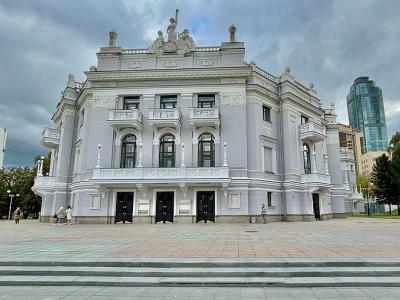
The building has a Classical structure with Baroque decorative details. A columned portico marks the main entrance, and stucco ornament and carved brackets decorate the façade. Above the doors, three sculpted Muses symbolize music, dance, and theater. A torch at the top recalls an old tradition of marking the start of performances and now glows again. Inside, the horseshoe-shaped auditorium offers good sightlines and acoustics, with red and gold tones, balconies, plaster decoration, and a central chandelier. Wide foyers and staircases support smooth audience movement.
Today, the theater works under the name Ural Opera Ballet and combines classical works with modern productions. Operas such as Eugene Onegin and La Traviata, and ballets like Swan Lake and Giselle, remain part of the core repertoire. At the same time, the theater presents new operas by contemporary Russian composers and modern ballets that use simple sets, video, and non-traditional movement. It also produces original works for its own ensemble, often shown during the Annual Festival of New Academic Art, which focuses on current trends in opera and ballet.
The building has a Classical structure with Baroque decorative details. A columned portico marks the main entrance, and stucco ornament and carved brackets decorate the façade. Above the doors, three sculpted Muses symbolize music, dance, and theater. A torch at the top recalls an old tradition of marking the start of performances and now glows again. Inside, the horseshoe-shaped auditorium offers good sightlines and acoustics, with red and gold tones, balconies, plaster decoration, and a central chandelier. Wide foyers and staircases support smooth audience movement.
Today, the theater works under the name Ural Opera Ballet and combines classical works with modern productions. Operas such as Eugene Onegin and La Traviata, and ballets like Swan Lake and Giselle, remain part of the core repertoire. At the same time, the theater presents new operas by contemporary Russian composers and modern ballets that use simple sets, video, and non-traditional movement. It also produces original works for its own ensemble, often shown during the Annual Festival of New Academic Art, which focuses on current trends in opera and ballet.
Walking Tours in Yekaterinburg, Russia

Create Your Own Walk in Yekaterinburg
Creating your own self-guided walk in Yekaterinburg is easy and fun. Choose the city attractions that you want to see and a walk route map will be created just for you. You can even set your hotel as the start point of the walk.
Historical Religious Buildings Tour
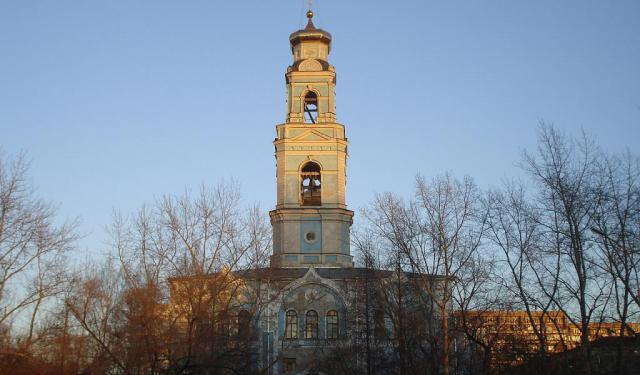
Yekaterinburg is a beautiful city with a rich religious history. Many churches managed to survive the wrath of the Soviet Union's anti-religious campaigns, and some have been renovated so they are more splendid than ever before. Take this tour to discover the striking architectural beauty of Yekaterinburg's churches and cathedrals.
Tour Duration: 2 Hour(s)
Travel Distance: 4.2 Km or 2.6 Miles
Tour Duration: 2 Hour(s)
Travel Distance: 4.2 Km or 2.6 Miles
The Most Popular Cities
/ view all