

Religious Buildings (Self Guided), Addis Ababa
Ethiopia is mainly a Christian country. However, there are many other religions of the world there as the country has many ethnic groups. Addis Ababa boasts very beautiful and old, Christian cathedrals and churches. There are also Catholic churches and mosques in the city. This self-guided tour will lead you to the great religious sights of Addis Ababa.
How it works: Download the app "GPSmyCity: Walks in 1K+ Cities" from Apple App Store or Google Play Store to your mobile phone or tablet. The app turns your mobile device into a personal tour guide and its built-in GPS navigation functions guide you from one tour stop to next. The app works offline, so no data plan is needed when traveling abroad.
Religious Buildings Map
Guide Name: Religious Buildings
Guide Location: Ethiopia » Addis Ababa (See other walking tours in Addis Ababa)
Guide Type: Self-guided Walking Tour (Sightseeing)
# of Attractions: 8
Tour Duration: 4 Hour(s)
Travel Distance: 9.5 Km or 5.9 Miles
Author: vickyc
Sight(s) Featured in This Guide:
Guide Location: Ethiopia » Addis Ababa (See other walking tours in Addis Ababa)
Guide Type: Self-guided Walking Tour (Sightseeing)
# of Attractions: 8
Tour Duration: 4 Hour(s)
Travel Distance: 9.5 Km or 5.9 Miles
Author: vickyc
Sight(s) Featured in This Guide:
- Nur Mosque
- St. George's Cathedral
- St. Mary Church
- Holy Trinity Cathedral
- Ba'etta Mariam Orthodox Church
- Gebi Gebriel Orthodox Church
- St. Stephen's Church
- San Salvador Church
1) Nur Mosque
Nur Mosque, also known as Benin Mosque or Nur Masjid, is one of the oldest Islamic sites in the area. It has served Muslim communities since the early years of the city’s growth and is often mentioned as older than the Grand Anwar Mosque. Today, it remains a busy place of worship, especially during Friday prayers and major Islamic holidays, when large numbers of worshippers gather.
The mosque has been rebuilt and renovated in recent years. The newer design adds domes, towers, and strong pillars, giving it a clearer visual presence. Inside, the prayer hall is open and spacious, with prayer carpets arranged in straight rows facing the qibla wall toward Mecca. High windows bring in light and air during services.
Nur Mosque is busiest during Ramadan, when evening prayers and shared meals take place after sunset. At other times, people visit throughout the day for short prayers. Visitors are usually welcome outside prayer hours if they dress modestly and remove their shoes before entering. A visit of about 20 to 30 minutes is enough to understand the mosque’s religious role and daily use.
The mosque has been rebuilt and renovated in recent years. The newer design adds domes, towers, and strong pillars, giving it a clearer visual presence. Inside, the prayer hall is open and spacious, with prayer carpets arranged in straight rows facing the qibla wall toward Mecca. High windows bring in light and air during services.
Nur Mosque is busiest during Ramadan, when evening prayers and shared meals take place after sunset. At other times, people visit throughout the day for short prayers. Visitors are usually welcome outside prayer hours if they dress modestly and remove their shoes before entering. A visit of about 20 to 30 minutes is enough to understand the mosque’s religious role and daily use.
2) St. George's Cathedral (must see)
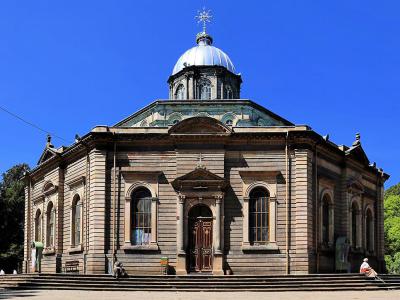
St. George's Cathedral is an important Ethiopian Orthodox church with strong ties to the country’s modern history. It was built in the early 1900s to honor Ethiopia’s victory over Italian forces at the Battle of Adwa in 1896. The church is dedicated to Saint George, who is widely respected in Ethiopia and often seen as a protector in times of struggle. From the start, the cathedral was meant to represent both religious faith and national independence.
The building has an octagonal shape, setting it apart from the more common round churches. Thick stone walls and arched windows give it a strong, balanced form, while a central dome rises above the roof. The design blends traditional Ethiopian church forms with European influences from the imperial period, and the many windows allow daylight to enter from several sides.
Inside, the cathedral is arranged mainly for worship. The inner sanctuary is separated and used only by priests, while worshippers stay in the outer areas. The walls are decorated with painted scenes from the Bible and images of saints, made in the Ethiopian Orthodox style with clear figures and bold colors. Some artworks also reflect the church’s connection to important historical events and leaders.
The cathedral has played a role in major national moments, including the coronation of Emperor Haile Selassie in 1930. It is still an active church today, with regular services and religious celebrations. Visitors are usually welcome outside service times if they dress modestly and remain respectful. A short visit helps explain the close link between religion, history, and public life.
The building has an octagonal shape, setting it apart from the more common round churches. Thick stone walls and arched windows give it a strong, balanced form, while a central dome rises above the roof. The design blends traditional Ethiopian church forms with European influences from the imperial period, and the many windows allow daylight to enter from several sides.
Inside, the cathedral is arranged mainly for worship. The inner sanctuary is separated and used only by priests, while worshippers stay in the outer areas. The walls are decorated with painted scenes from the Bible and images of saints, made in the Ethiopian Orthodox style with clear figures and bold colors. Some artworks also reflect the church’s connection to important historical events and leaders.
The cathedral has played a role in major national moments, including the coronation of Emperor Haile Selassie in 1930. It is still an active church today, with regular services and religious celebrations. Visitors are usually welcome outside service times if they dress modestly and remain respectful. A short visit helps explain the close link between religion, history, and public life.
3) St. Mary Church
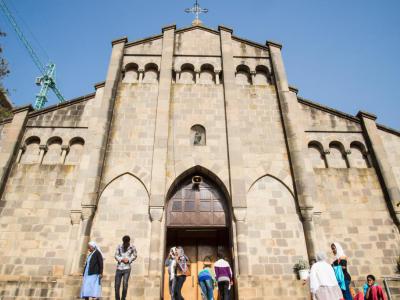
St. Mary Church (Entoto Maryam) was founded in 1877 by Emperor Menelik II and Empress Taytu Betul. At that time, the main seat of power was located on these hills. From here, Menelik ruled until the capital moved downhill around 1886–1887. The church is especially important as the place where Menelik II was crowned emperor in 1889, marking a key moment in modern Ethiopian history.
The church has an octagonal shape, common for Ethiopian Orthodox buildings of this time. Inside, it follows the traditional three-part layout, with spaces for singers, communion preparation, and an inner sanctuary reserved for priests. The walls show painted scenes from the Bible and Ethiopian history, including the Battle of Adwa, using strong, clear colors.
The compound includes remains of Menelik II’s former palace, such as his reception hall and bedroom, now part of a small museum with royal objects including the emperor’s bed, crowns, and a mirror linked to Queen Victoria. Set at about 3,200 meters above sea level, the site offers wide views. Visitors are usually welcome outside service times, with modest dress expected.
The church has an octagonal shape, common for Ethiopian Orthodox buildings of this time. Inside, it follows the traditional three-part layout, with spaces for singers, communion preparation, and an inner sanctuary reserved for priests. The walls show painted scenes from the Bible and Ethiopian history, including the Battle of Adwa, using strong, clear colors.
The compound includes remains of Menelik II’s former palace, such as his reception hall and bedroom, now part of a small museum with royal objects including the emperor’s bed, crowns, and a mirror linked to Queen Victoria. Set at about 3,200 meters above sea level, the site offers wide views. Visitors are usually welcome outside service times, with modest dress expected.
4) Holy Trinity Cathedral (must see)
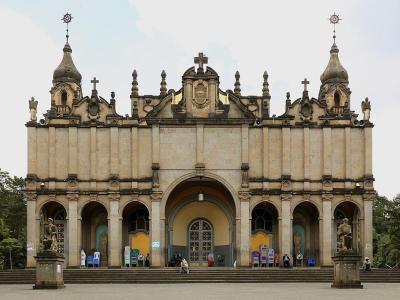
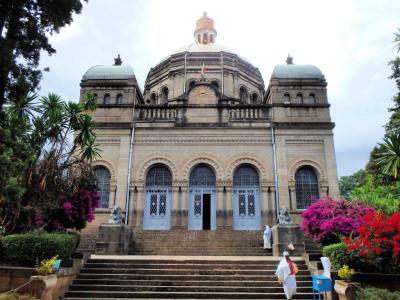
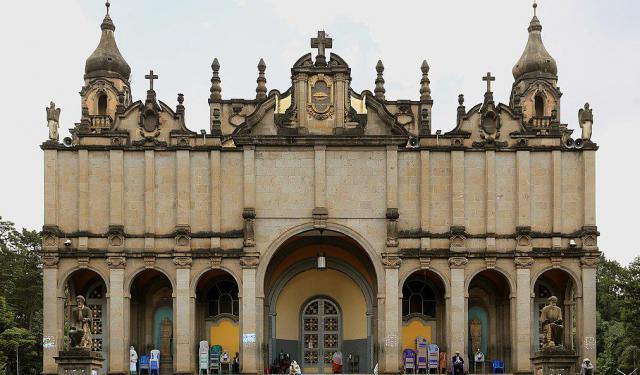
Holy Trinity Cathedral is one of the most important churches in Ethiopia and helps visitors understand the country’s recent history. Construction started in 1931 under Emperor Haile Selassie and was finished in 1942, after the end of the Italian occupation. The cathedral was built to mark Ethiopia’s independence and to remember those who resisted foreign rule. It is the main cathedral of the Ethiopian Orthodox Tewahedo Church and is still used for regular worship today.
The building combines traditional Ethiopian church features with European-style design. The exterior has a large dome, wide arches, and carved stone details. Inside, the space is bright and open, with painted ceilings, murals, and stained-glass windows showing biblical scenes and key figures from Ethiopian history. Changing light during the day highlights different parts of the interior.
The cathedral grounds also serve as a burial place for important figures. Emperor Haile Selassie and Empress Menen Asfaw are buried here, along with members of the imperial family and people known for their role in national resistance. A small museum on the site displays religious objects, church clothing, crowns, manuscripts, and old photographs. These items explain how religion, leadership, and public life were closely connected in the 20th century.
Most visitors spend about 45 to 60 minutes exploring the church and its grounds. Modest dress is expected, and some areas may be quieter during services. For tourists, the cathedral offers a clear and practical introduction to Ethiopian Orthodox traditions, religious art, and modern national history in one visit.
The building combines traditional Ethiopian church features with European-style design. The exterior has a large dome, wide arches, and carved stone details. Inside, the space is bright and open, with painted ceilings, murals, and stained-glass windows showing biblical scenes and key figures from Ethiopian history. Changing light during the day highlights different parts of the interior.
The cathedral grounds also serve as a burial place for important figures. Emperor Haile Selassie and Empress Menen Asfaw are buried here, along with members of the imperial family and people known for their role in national resistance. A small museum on the site displays religious objects, church clothing, crowns, manuscripts, and old photographs. These items explain how religion, leadership, and public life were closely connected in the 20th century.
Most visitors spend about 45 to 60 minutes exploring the church and its grounds. Modest dress is expected, and some areas may be quieter during services. For tourists, the cathedral offers a clear and practical introduction to Ethiopian Orthodox traditions, religious art, and modern national history in one visit.
5) Ba'etta Mariam Orthodox Church
Ba'etta Mariam Orthodox Church is closely linked to Emperor Menelik II and Ethiopia’s early 20th-century imperial history. It was commissioned in 1916 by his daughter, Empress Zewditu. Although historically important, it is not among the country’s oldest churches. The name “Ba’etta” refers to the Presentation of the Virgin Mary in the temple, a key feast day in the Ethiopian Orthodox tradition.
One of the church’s main roles is as a royal mausoleum. Beneath the building is a burial chamber where Emperor Menelik II, Empress Taytu, and Empress Zewditu are entombed. This underground crypt gives the church a strong connection to Ethiopia’s imperial past and makes it a place of remembrance as well as worship. For many visitors, this function is what sets the church apart from other Orthodox sites.
The church has a traditional round, sometimes described as octagonal, design. Its simple exterior is marked by a golden crown on the dome. Inside, the Holy of Holies is reserved for priests, while the outer walls are covered with colorful paintings of biblical scenes and Ethiopian saints. The church remains active, with chanting during services, and visitors are expected to dress modestly. Most visits last about 30 to 45 minutes.
One of the church’s main roles is as a royal mausoleum. Beneath the building is a burial chamber where Emperor Menelik II, Empress Taytu, and Empress Zewditu are entombed. This underground crypt gives the church a strong connection to Ethiopia’s imperial past and makes it a place of remembrance as well as worship. For many visitors, this function is what sets the church apart from other Orthodox sites.
The church has a traditional round, sometimes described as octagonal, design. Its simple exterior is marked by a golden crown on the dome. Inside, the Holy of Holies is reserved for priests, while the outer walls are covered with colorful paintings of biblical scenes and Ethiopian saints. The church remains active, with chanting during services, and visitors are expected to dress modestly. Most visits last about 30 to 45 minutes.
6) Gebi Gebriel Orthodox Church
Gebi Gebriel Orthodox Church is a lesser-known Ethiopian Orthodox church valued for its religious role and local history rather than its size. Church tradition places its establishment in the late 19th to early 20th century, a time when many churches were built or expanded. It is dedicated to Saint Gabriel, an important archangel linked to protection and healing, and has grown over time through community support.
The church complex follows traditional Ethiopian Orthodox design, with a circular main building divided into sacred zones and an inner area reserved for priests. Inside, wall paintings show biblical scenes, saints, and angels in a clear symbolic style. During services, visitors may hear chanting and see ritual objects such as prayer staffs and drums.
Life around the church is calm, with locals visiting for prayer and candle lighting. On feast days linked to Saint Gabriel, gatherings are larger and services last longer. Visitors are welcome outside active services, with modest dress required and shoes removed. A visit usually takes about 30 to 45 minutes and offers insight into living Orthodox traditions.
The church complex follows traditional Ethiopian Orthodox design, with a circular main building divided into sacred zones and an inner area reserved for priests. Inside, wall paintings show biblical scenes, saints, and angels in a clear symbolic style. During services, visitors may hear chanting and see ritual objects such as prayer staffs and drums.
Life around the church is calm, with locals visiting for prayer and candle lighting. On feast days linked to Saint Gabriel, gatherings are larger and services last longer. Visitors are welcome outside active services, with modest dress required and shoes removed. A visit usually takes about 30 to 45 minutes and offers insight into living Orthodox traditions.
7) St. Stephen's Church
St. Stephen's Church, known locally as St. Estifanos Church, is an important Ethiopian Orthodox place of worship. It was established in 1920 by Haile Selassie when he was still Crown Prince. After suffering damage, the church was repaired and updated in the 1930s, with further expansion later in the mid-20th century. Today, it remains a major religious center, especially during large festivals that draw thousands of worshippers.
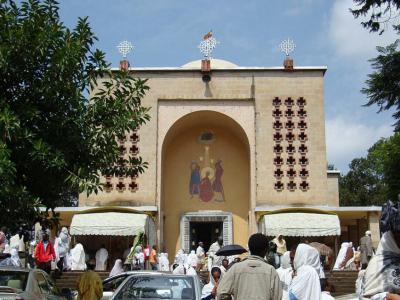
The exterior features a wide entrance with a three-domed gate that clearly defines the front of the church. The walls have repeated cross-shaped openings, which let in light and air and reflect Ethiopian Orthodox tradition. Above the entrance, a painted religious image marks the church’s spiritual role. The design is simple and practical, shaped by long-standing religious use.
Inside, the church follows the traditional three-part layout used in Ethiopian Orthodox worship.Inside, the church follows the traditional three-part layout. Inside, the church follows the traditional three-part layout, with public, communion, and priest-only spaces. It plays an important role during major events such as St. Estifanos Day, with Tabot processions, and Timkat (Epiphany). Visitors are welcome outside service times, with modest dress and respectful behavior expected.
The exterior features a wide entrance with a three-domed gate that clearly defines the front of the church. The walls have repeated cross-shaped openings, which let in light and air and reflect Ethiopian Orthodox tradition. Above the entrance, a painted religious image marks the church’s spiritual role. The design is simple and practical, shaped by long-standing religious use.
Inside, the church follows the traditional three-part layout used in Ethiopian Orthodox worship.Inside, the church follows the traditional three-part layout. Inside, the church follows the traditional three-part layout, with public, communion, and priest-only spaces. It plays an important role during major events such as St. Estifanos Day, with Tabot processions, and Timkat (Epiphany). Visitors are welcome outside service times, with modest dress and respectful behavior expected.
8) San Salvador Church
San Salvador Church was built during the Italian occupation of Ethiopia between 1936 and 1941. It first served the Italian Catholic community and later became the main Catholic church for the city. Its name means “Holy Savior,” reflecting its European origins, and it has remained active with a mixed local and international congregation.
Architecturally, the church differs from Ethiopian Orthodox buildings. It is often described as a large round structure with a tall Catholic-style tower. The red-brick exterior is simple, with little decoration, and the design reflects European church styles of the early 20th century rather than local traditions.
Inside, the church is simple and quiet, with an open space, plain seating, and a clear view of the altar. Unlike Orthodox churches, it has no large wall paintings or colorful frescoes. Soft natural light creates a calm setting for prayer. Services are held regularly, often in more than one language. Visitors may enter outside service times or observe quietly, and a visit usually takes about 20 to 30 minutes.
Architecturally, the church differs from Ethiopian Orthodox buildings. It is often described as a large round structure with a tall Catholic-style tower. The red-brick exterior is simple, with little decoration, and the design reflects European church styles of the early 20th century rather than local traditions.
Inside, the church is simple and quiet, with an open space, plain seating, and a clear view of the altar. Unlike Orthodox churches, it has no large wall paintings or colorful frescoes. Soft natural light creates a calm setting for prayer. Services are held regularly, often in more than one language. Visitors may enter outside service times or observe quietly, and a visit usually takes about 20 to 30 minutes.
Walking Tours in Addis Ababa, Ethiopia

Create Your Own Walk in Addis Ababa
Creating your own self-guided walk in Addis Ababa is easy and fun. Choose the city attractions that you want to see and a walk route map will be created just for you. You can even set your hotel as the start point of the walk.
North of Addis Ababa Walking Tour
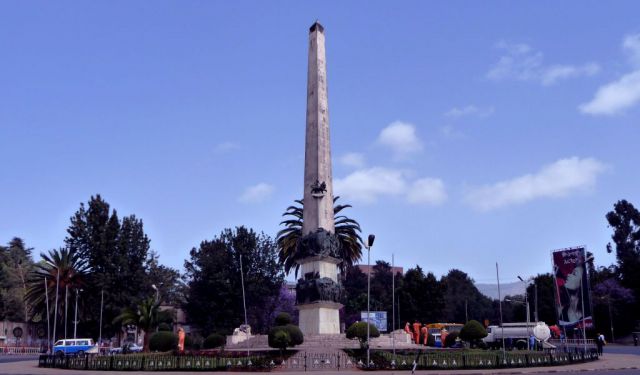
Some remarkable landmarks of Addis Ababa can be found in the north part of the city. There are monuments, beautiful buildings and the zoo where you can see lions walking. This self-guided tour will lead you through these attractions in the north of Addis Ababa.
Tour Duration: 2 Hour(s)
Travel Distance: 4.3 Km or 2.7 Miles
Tour Duration: 2 Hour(s)
Travel Distance: 4.3 Km or 2.7 Miles
Addis Ababa Introduction Walking Tour
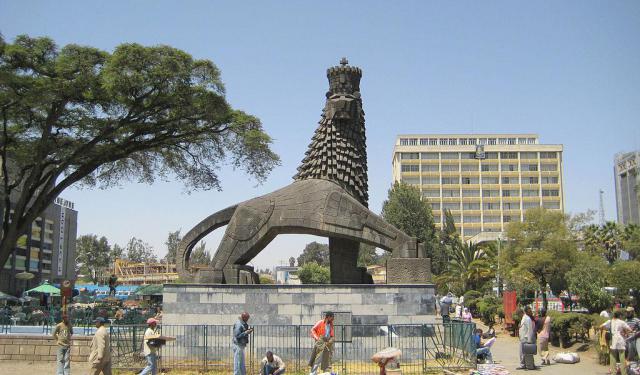
Addis Ababa, the capital of Ethiopia, is the country’s commercial and cultural hub, hosting a number of historic landmarks: monuments, squares, palaces and more. Among them the ones dedicated to the local Emperor Menelek and those commemorating the country's last, 20th-century emperor Haile Selassie. Follow this orientation walk to explore some of the top attractions of Addis Ababa.
Tour Duration: 3 Hour(s)
Travel Distance: 5.4 Km or 3.4 Miles
Tour Duration: 3 Hour(s)
Travel Distance: 5.4 Km or 3.4 Miles
The Most Popular Cities
/ view all