

Historical Churches Walking Tour (Self Guided), Strasbourg
Strasbourg, which celebrated its bimillennial anniversary in 1988, is a city with a very rich heritage. Among other historical monuments found here is a wealth of ancient churches and cathedrals, representing a variety of architectural styles. Exploring Strasbourg on foot, one is inevitably drawn to visit some of these locations. Here are some of the best known places of worship in the city.
Cathédrale Notre-Dame de Strasbourg (Strasbourg Cathedral) – famous for its astronomical clock and tower dominating the skyline; described by Victor Hugo as a "gigantic and delicate marvel", and by Goethe as a "sublimely towering, wide-spreading tree of God".
Église Saint-Pierre le Vieux (Old St. Peter's Church) – the oldest church in Strasbourg, first documented in 1130; with several vestiges from an older church, dated circa the 4th-8th centuries.
Saint-Thomas Church – the most unique and only "hall church" in Alsace; the site has been a place of worship since the 6th century AD as a shrine to Thomas the Apostle.
Saint-Nicolas Church – Jean Calvin preached here in 1538.
Saint William's Church – one of the most beautiful churches in Strasbourg, with its lopsided aspect adding to the charm.
If you're an ardent believer or an architecture buff or both of that, you might wish to spend some time to learn more about these and other historical churches of Strasbourg. For this, our self-guided walking tour will come in handy.
Cathédrale Notre-Dame de Strasbourg (Strasbourg Cathedral) – famous for its astronomical clock and tower dominating the skyline; described by Victor Hugo as a "gigantic and delicate marvel", and by Goethe as a "sublimely towering, wide-spreading tree of God".
Église Saint-Pierre le Vieux (Old St. Peter's Church) – the oldest church in Strasbourg, first documented in 1130; with several vestiges from an older church, dated circa the 4th-8th centuries.
Saint-Thomas Church – the most unique and only "hall church" in Alsace; the site has been a place of worship since the 6th century AD as a shrine to Thomas the Apostle.
Saint-Nicolas Church – Jean Calvin preached here in 1538.
Saint William's Church – one of the most beautiful churches in Strasbourg, with its lopsided aspect adding to the charm.
If you're an ardent believer or an architecture buff or both of that, you might wish to spend some time to learn more about these and other historical churches of Strasbourg. For this, our self-guided walking tour will come in handy.
How it works: Download the app "GPSmyCity: Walks in 1K+ Cities" from Apple App Store or Google Play Store to your mobile phone or tablet. The app turns your mobile device into a personal tour guide and its built-in GPS navigation functions guide you from one tour stop to next. The app works offline, so no data plan is needed when traveling abroad.
Historical Churches Walking Tour Map
Guide Name: Historical Churches Walking Tour
Guide Location: France » Strasbourg (See other walking tours in Strasbourg)
Guide Type: Self-guided Walking Tour (Sightseeing)
# of Attractions: 7
Tour Duration: 2 Hour(s)
Travel Distance: 3.0 Km or 1.9 Miles
Author: irenebo
Sight(s) Featured in This Guide:
Guide Location: France » Strasbourg (See other walking tours in Strasbourg)
Guide Type: Self-guided Walking Tour (Sightseeing)
# of Attractions: 7
Tour Duration: 2 Hour(s)
Travel Distance: 3.0 Km or 1.9 Miles
Author: irenebo
Sight(s) Featured in This Guide:
- Église Saint-Pierre le Vieux (Old St. Peter's Church)
- Saint-Thomas Church
- Saint-Nicolas Church
- Cathédrale Notre-Dame de Strasbourg (Strasbourg Cathedral)
- Sainte-Madeleine Church
- Saint William's Church
- Saint Paul Church
1) Église Saint-Pierre le Vieux (Old St. Peter's Church)
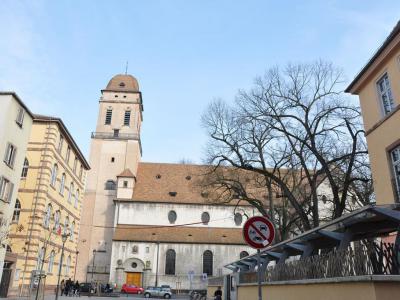
The Saint Pierre-le-Vieux Church stands as Strasbourg's oldest religious edifice, a definite highlight for any visitor.
Although its documented history dates back to 1130, remnants of a far more ancient structure, possibly from the 4th to 8th centuries, can be discerned within its walls. According to local lore, Saint Maternus himself may have overseen the construction of this early place of worship.
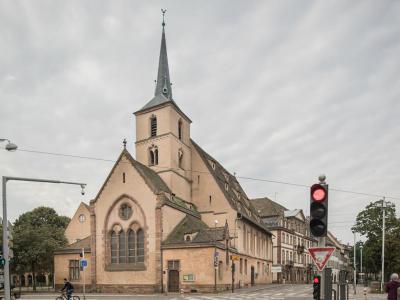
Today's iteration of the church was erected in 1382, an architectural marvel in that it served both Catholic and Protestant congregations. Initially under Catholic auspices from 1382 to 1529, it later transitioned to Lutheran control, a significant event that marked France's inaugural instance of a dual-religion church in 1638.
In response to the burgeoning Catholic community in 1867, architect Courath was entrusted with extending the original building perpendicularly. The evolution continued in 1912 when two bays were removed to accommodate the new Rue de 22 Novembre, an addition that also included a fresh facade and a bell tower.
Within the church's confines, one can marvel at the antique rood-screen. Adjacent to the partition dividing the two faiths, four reredos from the 15th century stand as poignant examples of artistry. Imprinted onto the choir's wooden framework are ten panels portraying the Passion of Christ, masterfully crafted by Hénri Lutzelmann in 1488.
Why You Should Visit:
Interesting architectural design and you can regularly listen to organ recitals that give life to the building.
Although its documented history dates back to 1130, remnants of a far more ancient structure, possibly from the 4th to 8th centuries, can be discerned within its walls. According to local lore, Saint Maternus himself may have overseen the construction of this early place of worship.
Today's iteration of the church was erected in 1382, an architectural marvel in that it served both Catholic and Protestant congregations. Initially under Catholic auspices from 1382 to 1529, it later transitioned to Lutheran control, a significant event that marked France's inaugural instance of a dual-religion church in 1638.
In response to the burgeoning Catholic community in 1867, architect Courath was entrusted with extending the original building perpendicularly. The evolution continued in 1912 when two bays were removed to accommodate the new Rue de 22 Novembre, an addition that also included a fresh facade and a bell tower.
Within the church's confines, one can marvel at the antique rood-screen. Adjacent to the partition dividing the two faiths, four reredos from the 15th century stand as poignant examples of artistry. Imprinted onto the choir's wooden framework are ten panels portraying the Passion of Christ, masterfully crafted by Hénri Lutzelmann in 1488.
Why You Should Visit:
Interesting architectural design and you can regularly listen to organ recitals that give life to the building.
2) Saint-Thomas Church
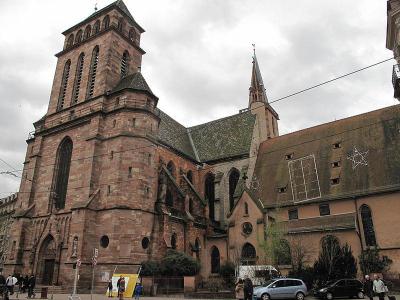
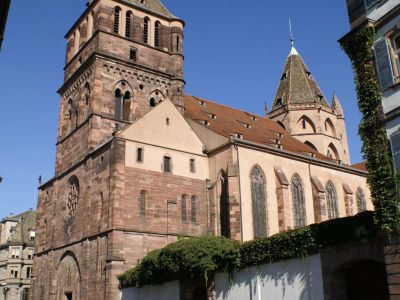
Saint-Thomas’ Church, situated in Strasbourg, stands out as the main Protestant church and the sole "hall church" in the area. A hall church is characterized by having the same height for its nave and side aisles, all under one roof. Saint-Thomas boasts five naves with side chapels on both the left and right sides of the apse.
The site's history as a place of worship dates back to the 6th century AD when a shrine was built here in honor of Thomas the Apostle. The original church, constructed in the 9th century, suffered fire damage in both 1007 and 1144. A new church project commenced in 1196, following the Roman architectural style, and it was completed in 1521 with the characteristics of Late Gothic architecture. Its tower gives it an appearance somewhat reminiscent of a fortress.
The church houses captivating and intricately adorned tombs that range from the lavish to the somewhat eerie. Notably, there's a detailed sarcophagus constructed in 1130 for Bishop Adelochus. Also, the tombstone of Nicholas Roeder von Tiersburg, erected in 1500, features a remarkable stone carving depicting his emaciated body.
However, the most awe-inspiring piece is undoubtedly the massive late Baroque mausoleum, built in 1777 by Jean-Baptiste Pigalle for Marshal Maurice de Sachs. Additionally, an extraordinary late Gothic fresco portraying Saint Michael and an original medieval rose window contribute to the church's allure.
The church is famous internationally for its historic organs. The 1741 Silbermann organ, crafted by the renowned German Silbermann family, was played by Mozart in 1778. It was restored in 1979 by Alfred Kern. Another notable organ is the 1905 one designed by Fritz Haerpfer, installed in 1906 based on Albert Schweitzer's concept. Organist Louis Thiry recorded Bach's 'The Art of Fugue' on this organ.
Tip:
Try to catch an organ recital on the same organ that was used by Mozart!
The site's history as a place of worship dates back to the 6th century AD when a shrine was built here in honor of Thomas the Apostle. The original church, constructed in the 9th century, suffered fire damage in both 1007 and 1144. A new church project commenced in 1196, following the Roman architectural style, and it was completed in 1521 with the characteristics of Late Gothic architecture. Its tower gives it an appearance somewhat reminiscent of a fortress.
The church houses captivating and intricately adorned tombs that range from the lavish to the somewhat eerie. Notably, there's a detailed sarcophagus constructed in 1130 for Bishop Adelochus. Also, the tombstone of Nicholas Roeder von Tiersburg, erected in 1500, features a remarkable stone carving depicting his emaciated body.
However, the most awe-inspiring piece is undoubtedly the massive late Baroque mausoleum, built in 1777 by Jean-Baptiste Pigalle for Marshal Maurice de Sachs. Additionally, an extraordinary late Gothic fresco portraying Saint Michael and an original medieval rose window contribute to the church's allure.
The church is famous internationally for its historic organs. The 1741 Silbermann organ, crafted by the renowned German Silbermann family, was played by Mozart in 1778. It was restored in 1979 by Alfred Kern. Another notable organ is the 1905 one designed by Fritz Haerpfer, installed in 1906 based on Albert Schweitzer's concept. Organist Louis Thiry recorded Bach's 'The Art of Fugue' on this organ.
Tip:
Try to catch an organ recital on the same organ that was used by Mozart!
3) Saint-Nicolas Church
Saint Nicholas Church (Église Saint Nicolas) is a petite Gothic-style church located in Strasbourg. In 1538, Jean Calvin conducted services and delivered sermons at this church. From 1900 to 1913, Albert Schweitzer served as the church's pastor and was known to play the organ there.
Over time, the church ceased to function as a parish due to the decreasing population in the central area of Strasbourg. Instead, a Charismatic group called "Renouveau Saint Nicholas" started using the church. This group, led by pastors Daniel Hebert and Pastor Ringerbach, began holding their Sunday services there in 1975.
The construction of the church took place between 1387 and 1454, replacing a prior church dedicated to Mary Magdalene that had been established by Knight Walther Spender in 1182. The earlier church was situated on the grounds of a former small Roman fort. The tower, which features an elegant tapering spire, was added in 1585. In the 17th century, the interior underwent remodeling. The architect Émile Salomon, who was responsible for the Temple Neuf in Strasbourg, designed the façade and sacristy in 1905.
Within the interior, fragments of frescoes from the 15th century still remain. The organ from 1707, crafted by the Silbermann brothers, was disassembled in 1967.
Over time, the church ceased to function as a parish due to the decreasing population in the central area of Strasbourg. Instead, a Charismatic group called "Renouveau Saint Nicholas" started using the church. This group, led by pastors Daniel Hebert and Pastor Ringerbach, began holding their Sunday services there in 1975.
The construction of the church took place between 1387 and 1454, replacing a prior church dedicated to Mary Magdalene that had been established by Knight Walther Spender in 1182. The earlier church was situated on the grounds of a former small Roman fort. The tower, which features an elegant tapering spire, was added in 1585. In the 17th century, the interior underwent remodeling. The architect Émile Salomon, who was responsible for the Temple Neuf in Strasbourg, designed the façade and sacristy in 1905.
Within the interior, fragments of frescoes from the 15th century still remain. The organ from 1707, crafted by the Silbermann brothers, was disassembled in 1967.
4) Cathédrale Notre-Dame de Strasbourg (Strasbourg Cathedral) (must see)
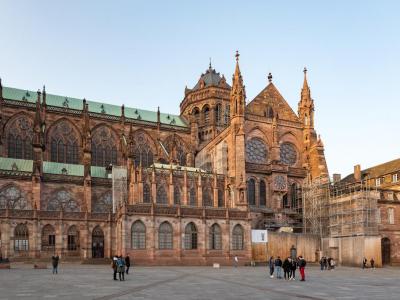
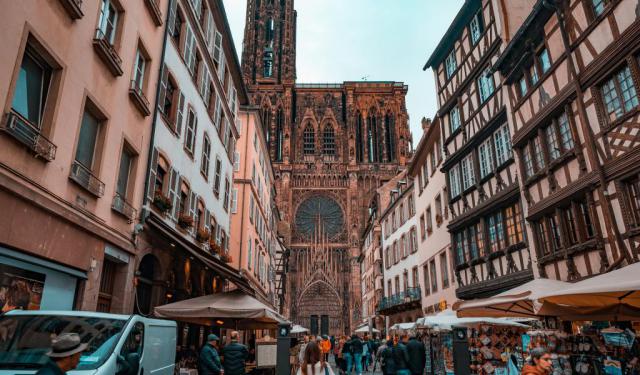
Victor Hugo described the Strasbourg Cathedral as a “gigantic and delicate marvel”, while Goethe praised it as “sublimely towering, a wide-spreading tree of God”. Its construction began in 1015 on the site of earlier religious buildings, including a Roman sanctuary. After a devastating fire in the 12th century, it was rebuilt in the emerging Gothic style, with work continuing until its completion in 1439. The result is a cathedral that blends Romanesque foundations with soaring Gothic forms, all built from the distinctive pink sandstone quarried in the nearby Vosges Mountains.
For centuries, Strasbourg Cathedral dominated not just the city but the world: its single spire reaches 142 metres, making it the tallest building on Earth from 1647 to 1874, and today still the tallest structure built entirely in the Middle Ages, as well as one of the tallest churches in the world. The cathedral’s western façade is a marvel of medieval sculpture; hundreds of intricately carved figures, biblical scenes, and allegorical motifs animate the stone, turning the exterior into a “book” of stories. The western façade is impossible to miss, as it is from here that the spire rises, and it also serves as the cathedral’s main entrance.
As you step inside, the interior proves just as rich. Stained-glass windows line the cathedral’s interior along both the north and south transepts. Many date from the 12th to the 14th centuries, filling the space with coloured light and depicting biblical narratives and saints. The cathedral also houses one of Europe’s most celebrated horological masterpieces, the Astronomical Clock. Moving forward from the entrance toward the main altar, a broad beige staircase marks the turning point; from here, the Astronomical Clock stands in the south transept. Its elaborate mechanisms and animated figures perform a remarkably intricate show each day at 12:30 pm.
Other interior highlights include the ornate stone pulpit, notable for its small sculpted dog, the sculptural Pillar of Angels, Baroque altars, and the monumental organ.
There is much to appreciate beyond simply admiring the cathedral’s beauty. Climbing the tower via its internal stairway rewards visitors with panoramic views over Strasbourg’s rooftops and the surrounding Alsatian plains.
Around the cathedral, Cathedral Square buzzes with life and is flanked by landmarks such as the Kammerzell House and the Rohan Palace museums, making the area a focal point of Strasbourg’s historic city centre.
For centuries, Strasbourg Cathedral dominated not just the city but the world: its single spire reaches 142 metres, making it the tallest building on Earth from 1647 to 1874, and today still the tallest structure built entirely in the Middle Ages, as well as one of the tallest churches in the world. The cathedral’s western façade is a marvel of medieval sculpture; hundreds of intricately carved figures, biblical scenes, and allegorical motifs animate the stone, turning the exterior into a “book” of stories. The western façade is impossible to miss, as it is from here that the spire rises, and it also serves as the cathedral’s main entrance.
As you step inside, the interior proves just as rich. Stained-glass windows line the cathedral’s interior along both the north and south transepts. Many date from the 12th to the 14th centuries, filling the space with coloured light and depicting biblical narratives and saints. The cathedral also houses one of Europe’s most celebrated horological masterpieces, the Astronomical Clock. Moving forward from the entrance toward the main altar, a broad beige staircase marks the turning point; from here, the Astronomical Clock stands in the south transept. Its elaborate mechanisms and animated figures perform a remarkably intricate show each day at 12:30 pm.
Other interior highlights include the ornate stone pulpit, notable for its small sculpted dog, the sculptural Pillar of Angels, Baroque altars, and the monumental organ.
There is much to appreciate beyond simply admiring the cathedral’s beauty. Climbing the tower via its internal stairway rewards visitors with panoramic views over Strasbourg’s rooftops and the surrounding Alsatian plains.
Around the cathedral, Cathedral Square buzzes with life and is flanked by landmarks such as the Kammerzell House and the Rohan Palace museums, making the area a focal point of Strasbourg’s historic city centre.
5) Sainte-Madeleine Church
Despite its relatively small size and lesser significance compared to larger churches in Strasbourg, Saint Madeleine Church possesses its own charm and is certainly a worthwhile destination for a visit. Originally established as part of the Sisters of Saint Mary Magdalene Convent in 1478, the church followed the Gothic architectural style of its time. Regrettably, only fragments of the original decorative frescoes in the chancel have survived to the present day.
Tragedy struck in 1904 when a fire ravaged the church, causing significant damage. While initial plans by the city council aimed to demolish the remaining ruins, architect Fritz Belbo intervened in 1907 with a proposal to reconstruct the church. The subsequent rendition of the church, designed in the Jugendstil (Art Nouveau) style, emerged larger and with a more airy ambiance than its predecessor. The interior, adorned in minimalist white tones, featured elegant arches and tall windows that welcomed sunlight, casting vibrant patterns across the floor.
The church, like many other structures in Strasbourg, endured substantial destruction during the bombings of World War II. Once again facing the threat of demolition, the church narrowly escaped this fate in 1958. It was eventually rebuilt according to Belbo's original vision, preserving its historical essence amidst the city's trials and tribulations.
Tragedy struck in 1904 when a fire ravaged the church, causing significant damage. While initial plans by the city council aimed to demolish the remaining ruins, architect Fritz Belbo intervened in 1907 with a proposal to reconstruct the church. The subsequent rendition of the church, designed in the Jugendstil (Art Nouveau) style, emerged larger and with a more airy ambiance than its predecessor. The interior, adorned in minimalist white tones, featured elegant arches and tall windows that welcomed sunlight, casting vibrant patterns across the floor.
The church, like many other structures in Strasbourg, endured substantial destruction during the bombings of World War II. Once again facing the threat of demolition, the church narrowly escaped this fate in 1958. It was eventually rebuilt according to Belbo's original vision, preserving its historical essence amidst the city's trials and tribulations.
6) Saint William's Church
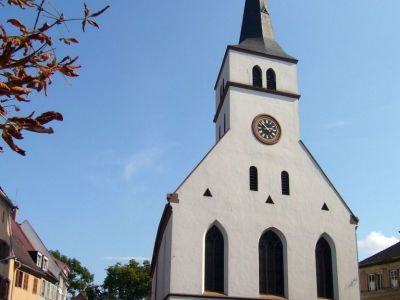
Saint William's Church, with its distinctively asymmetrical appearance, holds a unique charm and stands as one of Strasbourg's most exquisite churches. Originally, in 1307, a monastery was established on the swampy shores of the Ill River by Hénri de Mullenheim, a knight who survived the Crusades and sought to express his gratitude for his safe homecoming. This monastery served as the residence for mendicant monks belonging to the Order of the Hermits of Saint William. However, today only the church from the initial monastery complex endures.
Situated conveniently close to the docks, the church transitioned into the parish church for the Shipbuilders' Corporation in 1331. The 15th century witnessed the addition of a second entrance and a triple-arched gallery to the church's structure. Subsequently, during the late 16th century, the church experienced a period of relative neglect, which was eventually rectified through comprehensive renovations carried out in the 17th century.
Within the church, a significant historical artifact is a 14th century tomb effigy. This wooden relief, adorned with vibrant polychrome, portrays the conversion of both Saint Catherine and Saint William. Noteworthy elements within the church include a pulpit that dates back to 1656 and an altar installed during the 18th century.
While the organ itself was set up in 1987, its housing represents the original construction by Andreas Silbermann in 1728.
Situated conveniently close to the docks, the church transitioned into the parish church for the Shipbuilders' Corporation in 1331. The 15th century witnessed the addition of a second entrance and a triple-arched gallery to the church's structure. Subsequently, during the late 16th century, the church experienced a period of relative neglect, which was eventually rectified through comprehensive renovations carried out in the 17th century.
Within the church, a significant historical artifact is a 14th century tomb effigy. This wooden relief, adorned with vibrant polychrome, portrays the conversion of both Saint Catherine and Saint William. Noteworthy elements within the church include a pulpit that dates back to 1656 and an altar installed during the 18th century.
While the organ itself was set up in 1987, its housing represents the original construction by Andreas Silbermann in 1728.
7) Saint Paul Church
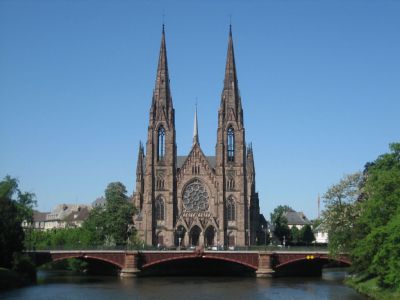
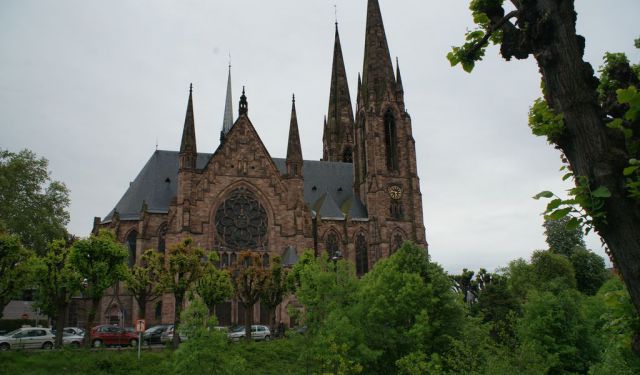
Strasbourg presents a multitude of enchanting destinations to explore, leaving you with the delightful dilemma of selecting from its array of attractions. Among these, Saint Paul’s Church stands out as a true gem, showcasing its Gothic Revival grandeur on the southern bank of an island nestled within the heart of the broadest section of the River Ill.
Originating in 1897, the edifice was constructed to cater to the Lutheran community of the Imperial German Army, who found residence in Strasbourg. Louis Muller designed this architectural marvel, drawing inspiration from Marburg's Elizabeth Church. The three large rose windows were modeled after one in Saint Thomas’ Church. The twin spires, soaring to a remarkable height of 76 meters, majestically grace the city's skyline.
The church's dimensions, wider than its length, and its incorporation of 19 distinct entrances, carry a unique historical significance. This layout was a deliberate manifestation of the army's hierarchy, meticulously assigning each portal according to rank, starting from the Emperor - during his stays - and extending down to the humble foot soldiers.
History, however, left its mark on the structure. The ravages of the Anglo-American bombings in 1944 inflicted considerable damage upon the building, including its stained glass windows. A subsequent severe hailstorm in 1958 further added to the woes of these windows. Today, the original stained glass windows remain only along the nave, and within the eastern and southern rose windows.
Beneath the rose window adorning the eastern transept, one can admire the heraldic banners representing Alsace, Baden, Bavaria, the Empire, Mecklenburg, and Prussia. Presiding within the church is a majestic pipe organ dating back to 1897, and it remains one of the largest in the Alsace region.
Originating in 1897, the edifice was constructed to cater to the Lutheran community of the Imperial German Army, who found residence in Strasbourg. Louis Muller designed this architectural marvel, drawing inspiration from Marburg's Elizabeth Church. The three large rose windows were modeled after one in Saint Thomas’ Church. The twin spires, soaring to a remarkable height of 76 meters, majestically grace the city's skyline.
The church's dimensions, wider than its length, and its incorporation of 19 distinct entrances, carry a unique historical significance. This layout was a deliberate manifestation of the army's hierarchy, meticulously assigning each portal according to rank, starting from the Emperor - during his stays - and extending down to the humble foot soldiers.
History, however, left its mark on the structure. The ravages of the Anglo-American bombings in 1944 inflicted considerable damage upon the building, including its stained glass windows. A subsequent severe hailstorm in 1958 further added to the woes of these windows. Today, the original stained glass windows remain only along the nave, and within the eastern and southern rose windows.
Beneath the rose window adorning the eastern transept, one can admire the heraldic banners representing Alsace, Baden, Bavaria, the Empire, Mecklenburg, and Prussia. Presiding within the church is a majestic pipe organ dating back to 1897, and it remains one of the largest in the Alsace region.
Walking Tours in Strasbourg, France
Create Your Own Walk in Strasbourg
Creating your own self-guided walk in Strasbourg is easy and fun. Choose the city attractions that you want to see and a walk route map will be created just for you. You can even set your hotel as the start point of the walk.
Famous Squares Walking Tour
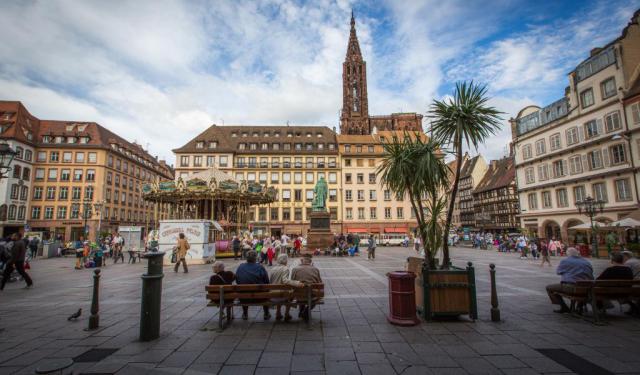
Justly reputed as one of the most beautiful cities in all of France, Strasbourg greets visitors with an array of picturesque squares. Among the most famous of them are:
Place Kléber – the biggest square in the heart of the city’s commercial district; a central meeting place since the 14th century.
Place Gutenberg – a definite “must-see” in the heart of medieval Strasbourg, not... view more
Tour Duration: 2 Hour(s)
Travel Distance: 2.7 Km or 1.7 Miles
Place Kléber – the biggest square in the heart of the city’s commercial district; a central meeting place since the 14th century.
Place Gutenberg – a definite “must-see” in the heart of medieval Strasbourg, not... view more
Tour Duration: 2 Hour(s)
Travel Distance: 2.7 Km or 1.7 Miles
Strasbourg Introduction Walking Tour
Decades of shifting rule between France and Germany eventually caught up with Strasbourg locals. They joked, "We change nationality as easily as others change their coats."
Strasbourg began as a Roman military outpost known as Argentoratum in the 1st century AD, part of the empire’s fortified Rhine frontier. After the fall of Rome, the settlement evolved under the Franks, eventually... view more
Tour Duration: 2 Hour(s)
Travel Distance: 2.8 Km or 1.7 Miles
Strasbourg began as a Roman military outpost known as Argentoratum in the 1st century AD, part of the empire’s fortified Rhine frontier. After the fall of Rome, the settlement evolved under the Franks, eventually... view more
Tour Duration: 2 Hour(s)
Travel Distance: 2.8 Km or 1.7 Miles
Strasbourg Downtown Walking Tour
German writer Johann Wolfgang von Goethe studied in Strasbourg between 1770 and 1771, a period he later described as highly formative. He gave back to the city by including his fascination for Strasbourg Cathedral's spire in his own autobiography.
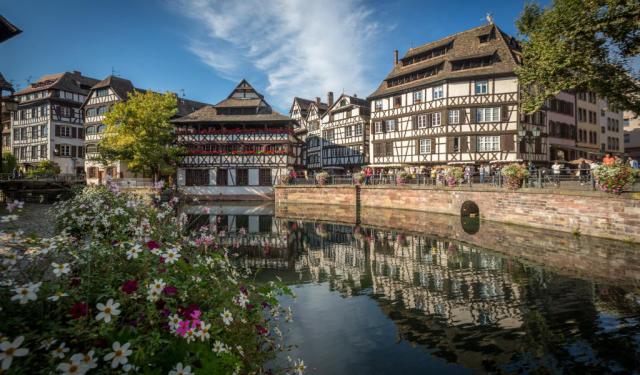
Strasbourg’s downtown, known as the "Large Island”, is the historic core of the city and one of the best-preserved medieval urban... view more
Tour Duration: 1 Hour(s)
Travel Distance: 1.5 Km or 0.9 Miles
Strasbourg’s downtown, known as the "Large Island”, is the historic core of the city and one of the best-preserved medieval urban... view more
Tour Duration: 1 Hour(s)
Travel Distance: 1.5 Km or 0.9 Miles
The Most Popular Cities
/ view all