

Strasbourg Introduction Walking Tour, Strasbourg

Audio Guide: Strasbourg Introduction Walking Tour (Self Guided), Strasbourg

Decades of shifting rule between France and Germany eventually caught up with Strasbourg locals. They joked, "We change nationality as easily as others change their coats."

Strasbourg began as a Roman military outpost known as Argentoratum in the 1st century AD, part of the empire’s fortified Rhine frontier. After the fall of Rome, the settlement evolved under the Franks, eventually becoming a prosperous medieval town. By the early Middle Ages, its name had shifted toward the Germanic Strateburgum or Strateburg, meaning "City of Roads" or "Fortress of the Roads". This etymology reflects Strasbourg’s long-standing identity as a crossroads of trade, cultures, and languages.

During the Middle Ages, Strasbourg grew into an important centre of commerce and craftsmanship. In 1262, following a conflict between the bishop and the citizens, it became a Free Imperial City of the Holy Roman Empire.

The 17th century brought new milestones. In 1605, Strasbourg became the birthplace of the world’s first printed newspaper — a sign of the city’s early embrace of ideas and communication.

Yet its modern image was most defined by its shifting national allegiance between France and Germany. It became French in 1681 under Louis XIV, a change that introduced new fortifications and closer political ties to Paris. After the Franco-Prussian War, the city was annexed by the newly unified German Empire in 1871, prompting major urban transformation, including the creation of the Neustadt district. Strasbourg returned to France after World War I, was annexed again during World War II, and was finally liberated by the Allied Army in 1944.

In the postwar era, Strasbourg embraced a new identity as a symbol of European cooperation. It became home to the Council of Europe in 1949, followed by the European Court of Human Rights and the European Parliament — institutions that anchor its role in shaping the continent’s future.

A visitor walking through central Strasbourg encounters half-timbered houses, narrow canals, and lively squares lined with cafés. The Strasbourg Cathedral dominates the skyline with its intricate Gothic façade and astronomical clock. Petite France offers postcard-like river views, while bridges and flower-decked quays frame the historic core. Museums, medieval lanes, and elegant 19th-century boulevards create a seamless blend of old and new within a UNESCO-listed district.

Today, the city’s architecture, cuisine, and multilingual heritage reflect its French and German influences. In a place where coats — and borders — changed often, the elegance of the city remained constant.
How it works: Download the app "GPSmyCity: Walks in 1K+ Cities" from Apple App Store or Google Play Store to your mobile phone or tablet. The app turns your mobile device into a personal tour guide and its built-in GPS navigation functions guide you from one tour stop to next. The app works offline, so no data plan is needed when traveling abroad.

Download The GPSmyCity App

Strasbourg Introduction Walking Tour Map

Guide Name: Strasbourg Introduction Walking Tour
Guide Location: France » Strasbourg (See other walking tours in Strasbourg)
Guide Type: Self-guided Walking Tour (Sightseeing)
# of Attractions: 8
Tour Duration: 2 Hour(s)
Travel Distance: 2.8 Km or 1.7 Miles
Author: irenebo
Sight(s) Featured in This Guide:
  • Place Kléber (Kleber Square)
  • Église protestante Saint-Pierre-le-Jeune (Young St. Peter's Protestant Church)
  • Place Broglie (Broglie Square)
  • Cathédrale Notre-Dame de Strasbourg (Strasbourg Cathedral)
  • Place Gutenberg (Gutenberg Square)
  • Petite France (Little France)
  • Pont Couverts (Covered Bridges)
  • Barrage Vauban (Vauban Dam)
1
Place Kléber (Kleber Square)

1) Place Kléber (Kleber Square) (must see)

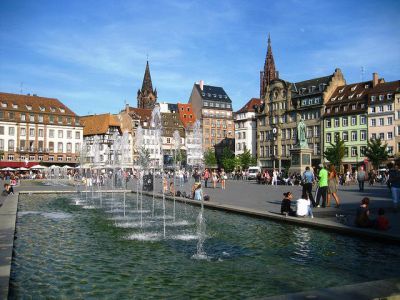
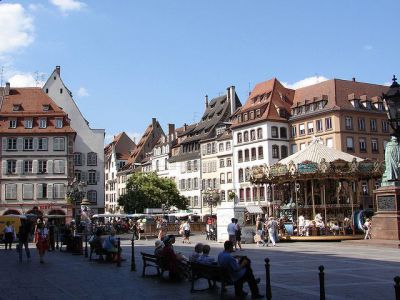
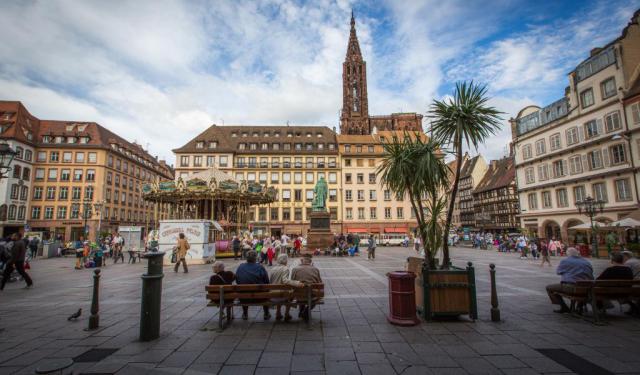
Kléber Square is the largest and most prominent square in Strasbourg, serving as the civic heart of the city for more than three centuries. Its history dates back to the late 17th and early 18th centuries, when Strasbourg—newly annexed by France under Louis XIV—began reshaping its urban fabric with grand public spaces. Originally named Weapons Square, the square hosted military drills and civic gatherings. It was renamed in 1840 in honour of General Jean-Baptiste Kléber, a Strasbourg-born military leader who rose to prominence during the French Revolutionary Wars as part of Napoleon's campaigns in 1798 and 1799. Kléber's ashes rest beneath the pyramid-shaped monument at the centre of the square, making it both a public plaza and a discreet memorial.

The buildings surrounding the square reflect layers of Strasbourg’s architectural past. Among them is the Aubette on the north side, built in the 18th century as a guardhouse and later transformed into a cultural venue. Its most intriguing feature today is the restored 1928 avant-garde interior—a masterpiece of the European modernist movement. This work of art is often called the "Sistine Chapel of Abstract Art" for its artistic beauty.

The square is also framed by elegant façades, wide pedestrian walkways, and the large Galeries Lafayette department store, which contributes to the area’s lively commercial character.

Visiting Kléber Square is one of the best ways to feel Strasbourg’s pulse. Outdoor cafés and seasonal markets occupy the square throughout the year, but it becomes especially atmospheric during the Strasbourg Christmas Market, when an immense Christmas tree and festive stalls transform it into a glowing winter scene. The square also functions as a central meeting point, with easy access to the historic district, Little France neighborhood, and nearby shopping streets.
2
Église protestante Saint-Pierre-le-Jeune (Young St. Peter's Protestant Church)

2) Église protestante Saint-Pierre-le-Jeune (Young St. Peter's Protestant Church)

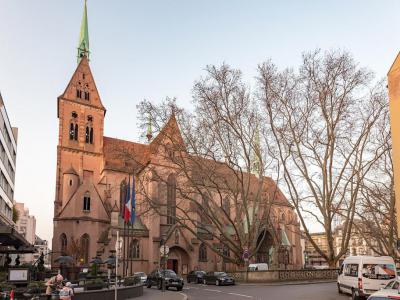
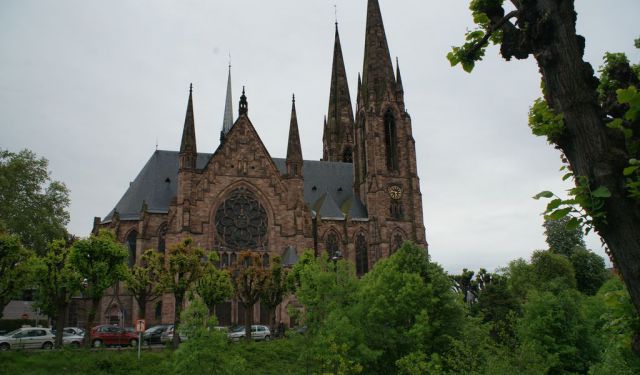
Young St. Peter’s Protestant Church traces its origins to the early medieval period, when a Merovingian church stood on this site. The present Gothic structure was built mainly between the 13th and 14th centuries, reflecting Strasbourg’s prosperity as a major free imperial city. For centuries following the Reformation, the church was shared by Catholics and Protestants in a rare arrangement known as simultaneum, until 1893, when it was fully assigned to the Protestant community.

From the outside, the south façade of the church features two doors. The door on the right is of particular interest, as it is protected by a Romanesque arch—one of the oldest surviving arches in Alsace. Its sculpted capitals and surviving fresco fragments hint at the building’s Romanesque past. Today, however, this doorway is no longer in use and is fenced off.

Instead, the left door serves as the main entrance and leads directly into the church interior. As you step into the nave, you can observe a richly carved wooden gallery, with the 18th-century organ positioned behind it. The ornate pulpit is slightly off to the side, set against a pillar to the left of the gallery. Throughout the interior, vibrant 14th-century wall paintings—restored in the 20th century—cover the pillars and choir, offering a rare glimpse into medieval artistic expression.

The church is also known for its intimate cloister garden, remarkably peaceful despite its city-centre location. You can reach it by turning left from the wooden gallery, which brings you to the north side of the church. Walk away from the gallery along the northern wall until you reach an open doorway leading into a secondary room. This room is easily recognized by its ceiling decorated with winged saints and a winged horse. From there, the door on the right leads directly into the cloister.

Young St. Peter’s Protestant Church remains an active cultural venue, hosting a programme of classical concerts that make full use of its excellent acoustics.
3
Place Broglie (Broglie Square)

3) Place Broglie (Broglie Square)

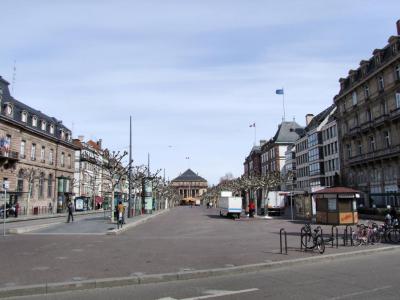
Broglie Square is one of the most important and historic public squares in Strasbourg, located in the city’s ancient centre, which is part of a UNESCO World Heritage Site. Originally the site of the medieval horse market, this long, rectangular square stretches about 275 m and has evolved over the centuries from a bustling trading place into a civic and cultural space framed by fine architecture.

Its modern identity began to take shape in the 18th century, when Marshal François-Marie de Broglie, then Governor of Alsace, transformed it into a shaded promenade by planting rows of trees and giving the square his name in 1740. In the early 19th century, the construction of the municipal theatre — now the Opéra national du Rhin — further defined the square’s layout and importance. Today, the surrounding buildings showcase a rich variety of architectural styles, from Renaissance and Rococo to Art Nouveau and Historicism. Notable civic buildings lining the square include the City Hall and the former Bank of France headquarters.

Broglie Square has also been the stage for key moments in French history. It was here, in April 1792, that "La Marseillaise," the French national anthem composed the night before, was first publicly sung in front of the City Hall. Monuments on the square commemorate historical figures and events, such as the Leclerc de Hauteclocque Liberation Monument, erected in 1951, and a statue celebrating "La Marseillaise."

Place Broglie remains a lively focal point of Strasbourg life. It hosts the city’s main outdoor markets on Wednesdays and Fridays and functions as a hub for local commerce. Most famously, it becomes one of the principal sites of Strasbourg’s celebrated Christmas market, held here since the 19th century and drawing crowds every winter with food, crafts, decorations, and a festive atmosphere. Even outside the holiday season, the square’s cafés, grand façades, monuments, and easy access by tram make it a pleasant place to stroll, relax, and absorb the heritage of the historic city.
4
Cathédrale Notre-Dame de Strasbourg (Strasbourg Cathedral)

4) Cathédrale Notre-Dame de Strasbourg (Strasbourg Cathedral) (must see)

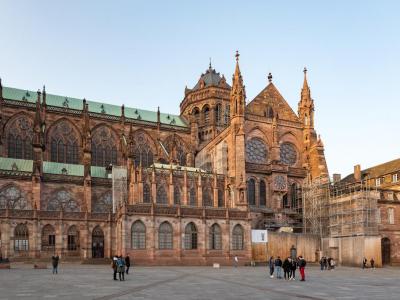
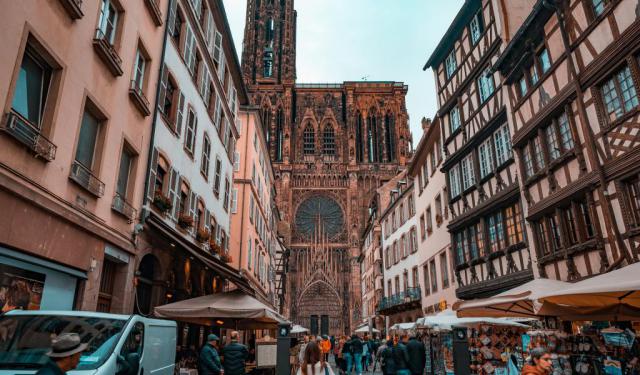
Victor Hugo described the Strasbourg Cathedral as a “gigantic and delicate marvel”, while Goethe praised it as “sublimely towering, a wide-spreading tree of God”. Its construction began in 1015 on the site of earlier religious buildings, including a Roman sanctuary. After a devastating fire in the 12th century, it was rebuilt in the emerging Gothic style, with work continuing until its completion in 1439. The result is a cathedral that blends Romanesque foundations with soaring Gothic forms, all built from the distinctive pink sandstone quarried in the nearby Vosges Mountains.

For centuries, Strasbourg Cathedral dominated not just the city but the world: its single spire reaches 142 metres, making it the tallest building on Earth from 1647 to 1874, and today still the tallest structure built entirely in the Middle Ages, as well as one of the tallest churches in the world. The cathedral’s western façade is a marvel of medieval sculpture; hundreds of intricately carved figures, biblical scenes, and allegorical motifs animate the stone, turning the exterior into a “book” of stories. The western façade is impossible to miss, as it is from here that the spire rises, and it also serves as the cathedral’s main entrance.

As you step inside, the interior proves just as rich. Stained-glass windows line the cathedral’s interior along both the north and south transepts. Many date from the 12th to the 14th centuries, filling the space with coloured light and depicting biblical narratives and saints. The cathedral also houses one of Europe’s most celebrated horological masterpieces, the Astronomical Clock. Moving forward from the entrance toward the main altar, a broad beige staircase marks the turning point; from here, the Astronomical Clock stands in the south transept. Its elaborate mechanisms and animated figures perform a remarkably intricate show each day at 12:30 pm.

Other interior highlights include the ornate stone pulpit, notable for its small sculpted dog, the sculptural Pillar of Angels, Baroque altars, and the monumental organ.

There is much to appreciate beyond simply admiring the cathedral’s beauty. Climbing the tower via its internal stairway rewards visitors with panoramic views over Strasbourg’s rooftops and the surrounding Alsatian plains.

Around the cathedral, Cathedral Square buzzes with life and is flanked by landmarks such as the Kammerzell House and the Rohan Palace museums, making the area a focal point of Strasbourg’s historic city centre.
5
Place Gutenberg (Gutenberg Square)

5) Place Gutenberg (Gutenberg Square) (must see)

Gutenberg Square is named after Johannes Gutenberg, the inventor of movable type, who lived and worked in Strasbourg during the 1430s, a formative period in the development of his printing techniques. Although Gutenberg’s most famous work would later emerge in Mainz, Strasbourg played an important role in shaping his ideas, and the square reflects the city’s pride in that intellectual legacy. The bronze statue of Gutenberg, erected in 1840, stands at the centre of the square and remains one of its most recognisable features.

Historically, the area developed as a commercial hub close to the cathedral, where merchants, craftsmen, and traders gathered in the late Middle Ages and the early modern period. Surrounding buildings reflect this mercantile past, with elegant façades dating mainly from the 18th and 19th centuries, blending classical proportions with Alsatian details. Among them is the former Chamber of Commerce building, recognisable for its Renaissance style and sloping Alsatian roof.

Gutenberg Square’s open layout provides clear views toward the cathedral spire, making it a natural pause while exploring the old town. Cafés and terraces line the edges of the square, creating an inviting place to sit and observe daily life in the historic centre. Seasonal events and small markets occasionally animate the space, but even on quieter days it remains a pleasant spot to absorb Strasbourg’s atmosphere.
6
Petite France (Little France)

6) Petite France (Little France) (must see)

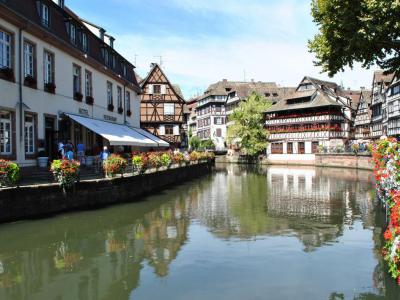
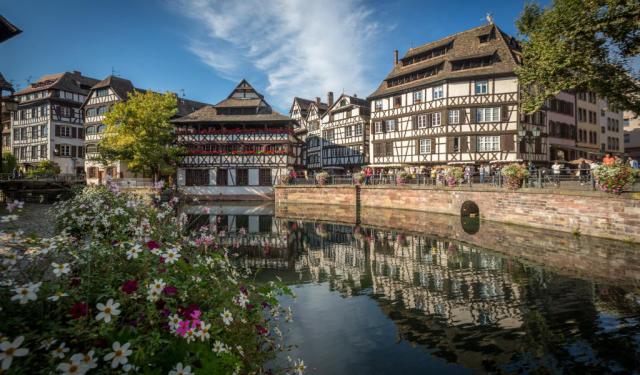
Little France is one of Strasbourg’s most picturesque and historically rich districts, known for its canals, half-timbered houses, and medieval atmosphere. Despite its romantic name, the quarter was not originally French in character. In the Middle Ages, this area lay just outside the main city centre and was home to tanners, millers, and fishermen whose trades depended on direct access to water. The canals of the Ill River powered mills and helped wash animal hides, making the district an important—if pungent—centre of craft production.

The name of the district emerged much later, in the 17th century, and has a darker origin. It refers to a hospice that treated soldiers suffering from syphilis, then known as the “French disease.” Over time, the name lost its grim association and came to describe the entire neighbourhood. While many industrial activities faded, the district’s architecture survived remarkably intact, preserving rows of timber-framed houses from the 16th and 17th centuries with steep roofs, wooden galleries, and colourful façades.

Today, Little France is one of Strasbourg’s most popular areas to explore on foot. Narrow lanes wind between canals and locks, while flower-lined bridges offer postcard views in every direction. Highlights include the Tanners’ House, once a guild house for tanners and now a restaurant, as well as the Covered Bridges and the Vauban Dam at the western edge of the district.

The appeal lies in both atmosphere and accessibility. Cafés and traditional winstubs serve Alsatian specialties such as sauerkraut, while riverside terraces invite lingering pauses. Boat tours glide through the canals, offering a different perspective on the historic buildings. In every season—but especially in spring and during the Christmas markets—Little France captures Strasbourg’s blend of Germanic and French heritage, combining history, architecture, and everyday city life into one of the city’s most memorable quarters.
7
Pont Couverts (Covered Bridges)

7) Pont Couverts (Covered Bridges) (must see)

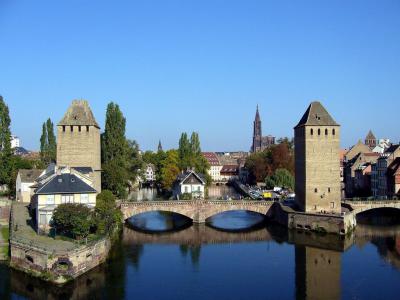
The Covered Bridges of Strasbourg mark the western edge of the historic centre, where the Ill River divides into a network of canals. Despite their name, the bridges themselves are no longer covered; instead, it was the three square defensive towers beside them that once supported wooden roofs. Built in the 13th century, the bridges formed part of Strasbourg’s medieval fortifications, guarding a key approach to the city and controlling river traffic entering the old town.

Originally, the complex consisted of several towers connected by wooden bridges that spanned the canals. These structures played a crucial defensive role, allowing soldiers to monitor trade routes and protect the city during periods of conflict. By the 17th century, advances in artillery made the medieval defenses obsolete, leading to the construction of the Vauban Dam just behind the bridges as part of a more modern fortification system.

Today, the Covered Bridges are valued less for defense and more for their atmosphere and views. Walking across them offers striking perspectives of the Little France district, with its half-timbered houses, canals, and locks, as well as distant views of Strasbourg Cathedral rising above the rooftops. Each tower can be closely observed from the outside, revealing details such as arrow slits and stonework shaped by centuries of wear.

The bridges are a natural stopping point when exploring the historic center. They connect easily with riverside paths and nearby landmarks, making them ideal for photography and leisurely walks. In the evening, subtle lighting highlights the towers and water below, creating one of Strasbourg’s most evocative scenes.
8
Barrage Vauban (Vauban Dam)

8) Barrage Vauban (Vauban Dam) (must see)

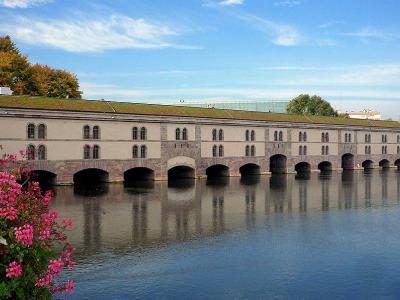
The Vauban Dam was built between 1681 and 1688, shortly after Strasbourg was annexed by France under Louis XIV. The dam was designed by the city’s military engineers following the principles of Sébastien de Vauban, France’s most influential fortress architect. Its primary purpose was strategic: in the event of an attack, the dam could be used to flood the southern approaches to the city by controlling the flow of the Ill River, creating a water barrier that made invasion far more difficult.

Architecturally, the Vauban Dam is a long, covered stone structure spanning the river just behind the medieval Covered Bridges. Inside, a vaulted gallery runs the length of the dam, pierced by large arches that allow water to pass through. These openings once held wooden gates that could be raised or lowered to regulate water levels.

Today, the Vauban Dam is valued less as a military installation and more as a viewpoint and cultural landmark. The interior gallery is open to visitors and often hosts temporary art installations and exhibitions. The gallery is easily accessible via an arched gateway on the side of the dam.

Two staircases and an elevator inside the dam lead to a rooftop terrace that offers one of the best panoramic views in Strasbourg. The staircases can be identified by signs reading “terrasse panoramique,” meaning “panoramic terrace.” From here, you can look out over the canals and half-timbered houses of the Little France district on one side, and toward the towers of Strasbourg Cathedral and the historic city center on the other. The contrast between medieval neighborhoods, waterways, and later fortifications is especially striking from this elevated position.

Walking Tours in Strasbourg, France

Create Your Own Walk in Strasbourg

Create Your Own Walk in Strasbourg

Creating your own self-guided walk in Strasbourg is easy and fun. Choose the city attractions that you want to see and a walk route map will be created just for you. You can even set your hotel as the start point of the walk.
Historical Churches Walking Tour

Historical Churches Walking Tour

Strasbourg, which celebrated its bimillennial anniversary in 1988, is a city with a very rich heritage. Among other historical monuments found here is a wealth of ancient churches and cathedrals, representing a variety of architectural styles. Exploring Strasbourg on foot, one is inevitably drawn to visit some of these locations. Here are some of the best known places of worship in the city.

...  view more

Tour Duration: 2 Hour(s)
Travel Distance: 3.0 Km or 1.9 Miles
Famous Squares Walking Tour

Famous Squares Walking Tour

Justly reputed as one of the most beautiful cities in all of France, Strasbourg greets visitors with an array of picturesque squares. Among the most famous of them are:

Place Kléber – the biggest square in the heart of the city’s commercial district; a central meeting place since the 14th century.

Place Gutenberg – a definite “must-see” in the heart of medieval Strasbourg, not...  view more

Tour Duration: 2 Hour(s)
Travel Distance: 2.7 Km or 1.7 Miles
Strasbourg Downtown Walking Tour

Strasbourg Downtown Walking Tour

German writer Johann Wolfgang von Goethe studied in Strasbourg between 1770 and 1771, a period he later described as highly formative. He gave back to the city by including his fascination for Strasbourg Cathedral's spire in his own autobiography.

Strasbourg’s downtown, known as the "Large Island”, is the historic core of the city and one of the best-preserved medieval urban...  view more

Tour Duration: 1 Hour(s)
Travel Distance: 1.5 Km or 0.9 Miles