

NYC Greenwich Village Walking Tour, New York

NYC Greenwich Village Walking Tour (Self Guided), New York

Seeing Manhattan as a neatly pressed suit, one can easily imagine Greenwich Village as the shirt stubbornly refusing to stay tucked in. Its tree-lined streets, classic brownstones, and endless supply of cafés, jazz clubs, and Off-Broadway theaters have lured generations of writers, poets, artists, radicals, and runaways looking for a life less ordinary. This reputation was cemented in the mid-20th century by the counterculture writers like Jack Kerouac, Allen Ginsberg, and James Baldwin, and musician Bob Dylan, who helped define the Village’s role as New York’s unofficial headquarters of creative rebellion.

The neighborhood’s refusal to follow the rules goes way back. What began as a Lenape settlement eventually morphed into Groenwijck, a small Dutch hamlet in the 1600s. When downtown epidemics pushed New Yorkers northward in the early 19th century, the Village became a quieter, suburban escape, keeping the quirky street plan that still baffles GPS systems today. Wander around, and you’ll notice stretches that feel much as they did two centuries ago, where historic buildings mingle with young, innovative restaurants and attractive storefronts that practically dare you to wander in.

Throughout the 1800s, the place established itself as a sanctuary for thinkers, writers, and assorted free spirits. Washington Square Park and the Jefferson Market Courthouse shaped the neighborhood’s public life, while the arrival of New York University in 1831 added a steady stream of students ready to debate anything with anyone.

Spin ahead to the early 20th century, and the Village blossomed into America’s favorite bohemian playground. Edna St. Vincent Millay, Eugene O’Neill, and the Ashcan School painters added their voices to the creative din, while low rents and open-minded attitudes made it an early gathering spot for LGBTQ+ communities.

Post World War II, Greenwich Village entered another influential chapter, when the Beat writers scribbled late into the night, folk musicians filled smoky rooms, and activists marched for civil rights. The Stonewall uprising of 1969, sparked at the Stonewall Inn on Christopher Street, would echo far beyond the neighborhood.

Today, Washington Square Park, the cobbled charm of Washington Mews, the Jefferson Market Library, Grove Court, and The Bitter End all speak to the Village’s layered past. Through every era, this pocket of Manhattan stayed true to itself: a place where creativity gathers, ideas collide, and the unconventional feels right at home.
How it works: Download the app "GPSmyCity: Walks in 1K+ Cities" from Apple App Store or Google Play Store to your mobile phone or tablet. The app turns your mobile device into a personal tour guide and its built-in GPS navigation functions guide you from one tour stop to next. The app works offline, so no data plan is needed when traveling abroad.

Download The GPSmyCity App

NYC Greenwich Village Walking Tour Map

Guide Name: NYC Greenwich Village Walking Tour
Guide Location: USA » New York (See other walking tours in New York)
Guide Type: Self-guided Walking Tour (Sightseeing)
# of Attractions: 8
Tour Duration: 1 Hour(s)
Travel Distance: 2.2 Km or 1.4 Miles
Author: doris
Sight(s) Featured in This Guide:
  • Washington Square Park
  • Washington Mews
  • Jefferson Market Library
  • Christopher Street
  • Grove Street
  • MacDougal Street
  • Caffe Reggio
  • Bleecker Street
1
Washington Square Park

1) Washington Square Park

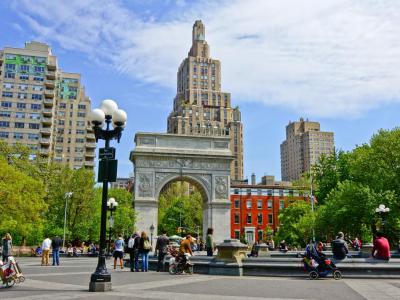
If you’ve ever walked into Washington Square Park and felt like you’d stepped into a living postcard—with guitar strummers on one side, chess hustlers on the other, and NYU students cutting classes everywhere in between—you’re only catching the latest chapter of a very long story. Washington Square Park has spent decades adapting to the moods and needs of the city before becoming a go-to meeting point for just about anyone looking for a slice of New York at a human scale.

Hard to believe, but this lively hangout began as a marshy river delta, the kind of soggy patch colonial New Yorkers happily ignored. By the late 1700s, it took on a far grimmer role as a potter’s field, the final resting place for the city’s poor, unnamed, and unlucky victims of yellow fever. Not exactly the picnic-friendly image it has today...

As New York crept north in the early 19th century, the cemetery closed, and the land was re-imagined as a military parade ground—flat, open, and surprisingly forward-thinking for a space that once swallowed rainwater like a sponge. Then, in 1833, the city decided to celebrate the 50th anniversary of George Washington’s inauguration by giving the area a makeover and the name Washington Square. Neat paths, tidy lawns, and new plantings drew well-to-do residents, who lined the northern edge with elegant Greek Revival townhouses. Instantly, the place gained its reputation as a cultured corner of the growing city.

Toward the late 1800s, the Village’s bohemian spirit took over. Artists, writers, and performers treated the square as an outdoor salon, and the unveiling of Stanford White’s triumphal arch in 1892 sealed its status as a civic icon.

The mid-20th century delivered a bit of drama when planners tried to ram Fifth Avenue straight through the park. Luckily, that idea didn't materialize thanks to the fierce community pushback, which saved the space and reshaped urban activism in the process.

Today, Washington Square Park is a compact but electric patch of green—fountain, lawns, and shade—packed with locals walking their dogs, and a rotating cast of social-media hopefuls striking poses like it’s a paid gig. It’s the Village’s open-air living room, surrounded by historic streets and endless spots to grab a coffee, a snack, or just catch that “authentic Village moment,” while sitting and watching the world swirl by...
2
Washington Mews

2) Washington Mews

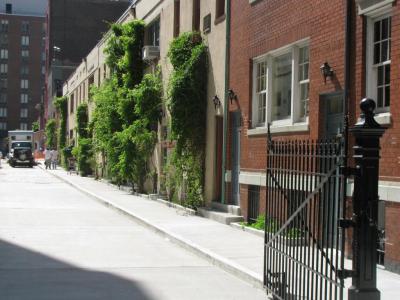
Perhaps one of New York’s worst-kept best secrets, Washington Mews seems like the place where the city hides its calm... A tiny cobblestone lane just steps from Washington Square Park, it looks like it fell out of a history book and landed in Greenwich Village by accident. Ivy-draped, two-story houses line the path, giving the whole place the air of a neighborhood that politely declined to join the rest of Manhattan in the 21st century.

Its story goes back to the early 1800s, when this narrow strip served as the backstage area for the grand Greek Revival mansions on Washington Square North. The elite had the fancy façades out front and, back here, the horses, carriages, and staff. Those first carriage houses were simple and practical—proof that even New York’s most fashionable residents once relied on a small army of stablehands to keep things running...

Jump ahead to the early 20th century, and the Mews started reinventing itself. With carriages fading out, those old stables found new life as studios and petite homes. A mix of wealthy residents and Village creatives moved in, and architects like Maynicke & Franke gave the buildings fresh façades in neo-Federal and Arts-and-Crafts styles. The result was a street that suddenly felt half-New York, half-old-world hideaway, and entirely irresistible to painters, writers, and musicians looking for quiet corners.

By the mid-1900s, New York University stepped in and took over much of the lane. From the 1950s onward, the buildings shifted into academic offices, faculty apartments, and spaces for cultural programs—all while keeping the Mews’ charming bones intact.

Today, the street is privately managed but frequently admired through its iron gates, which are usually open during the day. People wander in for the calm, the architecture, the color-splashed doors, and that rare Manhattan feeling that time decided to slow down for a minute. Washington Mews may be small, but it carries layers of history with surprising grace—and just enough quiet to make you think you’ve stumbled onto a secret...
3
Jefferson Market Library

3) Jefferson Market Library

Check out Greenwich Village's own fairy-tale structure that once served as a courthouse, market, and community battleground—welcome to the Jefferson Market Library! Its story dates back to 1833, when this corner of the Village wasn’t trendy but practical. A country market stood here, complete with a wooden fire watchtower and a 9,000-pound bell that probably woke half of Manhattan before alarms were a thing. Fishermen, vegetable sellers, and poultry merchants packed the stalls until the entire setup was cleared in 1877 to make way for a very different kind of local attraction.

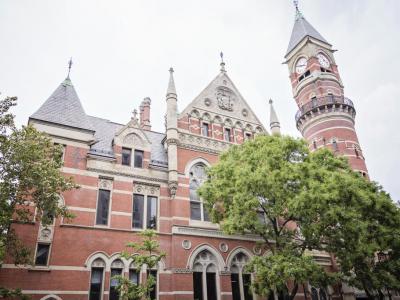
That replacement was the Jefferson Market Courthouse, a High Victorian Gothic creation by Frederick Clarke Withers and Calvert Vaux—the latter being the same guy who helped shape Central Park. With its multicolored brickwork, sharp arches, and flamboyant clock tower, the building immediately stole the show. In fact, by 1885, a national architectural poll ranked it among the ten most beautiful buildings in the United States, proving that the Village has always had a flair for style...

For decades, the courthouse was the neighborhood’s unofficial drama stage. Court cases came and went, tracking the city’s shifting social trends, while a nearby jail—later turned into a women’s detention center—added another layer to the block’s complicated personality. By the mid-20th century, the building found itself on the brink of demolition, targeted by the era’s sweeping urban renewal plans.

That’s when Village residents stepped in, rallied hard, and won. Their preservation campaign led architect Giorgio Cavaglieri to reinvent the building rather than erase it. In 1967, the former courthouse reopened as a New York Public Library branch, setting a national example for how to re-imagine civic landmarks without flattening them.

Today, the clock tower still crowns the neighborhood, the old courtroom has a second life as a reading room, and details like the spiral staircase give the place its delightful, slightly theatrical charm. With a guest pass, you can wander through the upper floors, then unwind in the small public garden next door—a pocket of calm for anyone needing a breather from Manhattan’s nonstop rhythm.
4
Christopher Street

4) Christopher Street

These days, younger LGBTQ+ crowds may be busy brunching in Chelsea, bar-hopping in Hell’s Kitchen, or perfecting their irony levels somewhere in Brooklyn, but Christopher Street still beats as the symbolic heart of New York’s queer community. Long before rainbow capitalism, this was the turf of a bohemian scene that mixed creativity, rebellion, and more than a little sexual freedom.

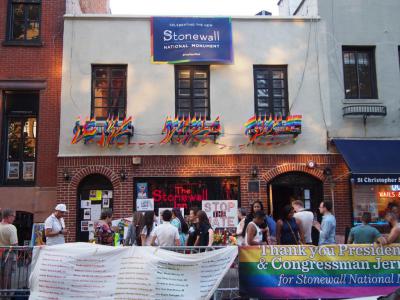
Walk past the cafés and the leather shops, and you’ll arrive at the legendary Stonewall Inn—once Mafia-run, now proudly draped in rainbow flags and serving up karaoke instead of covert back-room dealings. This is where the 1969 Stonewall Riots erupted, those spontaneous, fiery clashes often called the most pivotal moment in the fight for LGBTQ+ rights. Across the street, you’ll find Christopher Park, a small gated triangle that somehow manages to squeeze in commemorative statues of four white-painted figures—a same-sex male couple and a same-sex female couple—striking poses since 1992, along with a couple of Civil War heroes who ended up sharing the space whether they planned to or not.

Keep heading down the street, and you’ll hit No. 121, home to the Lucille Lortel Theatre. This Off-Broadway gem has launched new voices, revived old masterpieces, and hosted more playwright drama than any rehearsal room ever should. Looking down at the sidewalk, you’ll spot engraved bronze stars carrying names like Eugene Ionesco and Edward Albee—indeed, even the pavement here has better theater credentials than most people’s résumés...

Christopher Street might no longer be the center of queer nightlife, but its history echoes through every storefront and star plaque you pass.
5
Grove Street

5) Grove Street

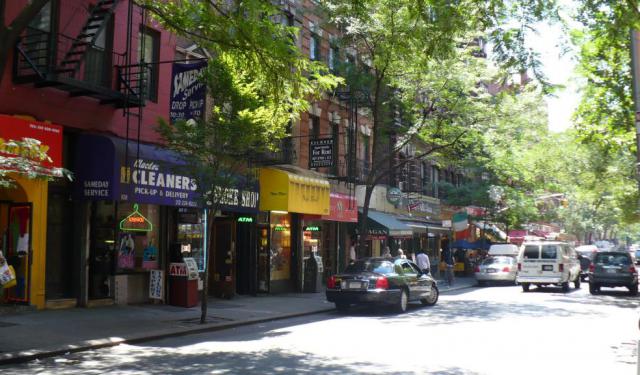
Grove Street may only stretch across five blocks, but it packs more personality than some avenues three times its size. It’s one of those Village lanes where the trees lean in, the brick glows warm, and every corner feels like it’s auditioning for the role of “Most Charming Street in Manhattan.” And honestly, it might get the part...

Let’s start at No. 59, home to the legendary MARIE’S CRISIS—half piano bar, half neighborhood time capsule, and partly named after Thomas Paine’s fiery essay “The American Crisis.” Step inside, and you’re immediately handed a soundtrack: show tunes, belted unapologetically by a crowd that frequently includes off-duty Broadway performers. It’s loud, it’s warm, it’s gloriously chaotic, and yes—you will be encouraged to sing. Resistance is futile...

A few doors down, Grove Street switches gears and shows off some of its architectural gems. At 17 Grove, an 1822 wooden-frame house stands with the quiet confidence of someone who’s seen centuries of renters come and go. And just nearby, tucked between Nos. 10 and 12, is the famously elusive Grove Court—a gated little alley where six brick townhouses from the 1850s pose like they’re on the cover of a period-drama DVD. You can’t go in, but you can absolutely peer in like everyone else.

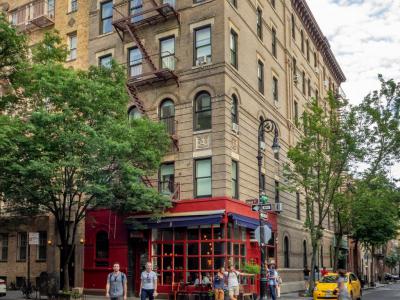
Grove then meets Bedford Street, one of the Village’s oldest byways. On the corner, above The Little Owl, you’ll usually spot a small crowd photographing the building known worldwide as “Monica’s apartment” from Friends. Spoiler: that popular '90s sitcom was filmed entirely in Los Angeles, but the façade here gets the glory.

And before you wander off: swing by 102 Bedford to see “Twin Peaks,” an early artists’ residence crowned with a quirky double-gabled roof. Then head to No. 86, where the unmarked door of CHUMLEY’S hides one of New York’s classic Prohibition-era speakeasies. Push inside, and you’re stepping straight into Village lore—no password required...
6
MacDougal Street

6) MacDougal Street

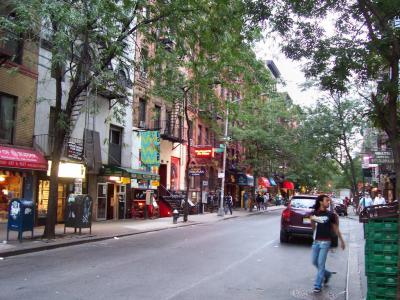
MacDougal Street is one of those New York blocks where the past still hums under the neon. From the 1920s through the ’70s, this was the Village’s cultural nerve center—poets arguing over espresso, future rock legends tuning up in cramped basements, and painters pretending their rent was optional... These days, you’re more likely to dodge clusters of students hunting late-night snacks than stumble upon the next Bob Dylan, but the energy hasn’t gone anywhere. It’s just swapped berets for backpacks.

If you want proof, head straight to “CAFE WHA?” The spirit of rock ’n’ roll never left the building—mostly because it refuses to. Bob Dylan and Jimi Hendrix once jammed here, and the nightly house band keeps the tradition alive with a high-octane mix of rock, soul, and reggae. They’ll hit something you love if you stick around long enough. Drinks arrive fast; the food, well… maybe consider it a pre-show snack and not dinner.

MacDougal also doubles as an international food runway. Mamoun’s Falafel dishes out legendary Middle-Eastern classics until 5 a.m.—perfect for anyone whose night doesn’t understand the concept of “closing time.” Craving Indian street food? The Kati Roll Company and Thelewala are your flavor bomb shelters. And for families—or anyone feeling fancy—there’s Minetta Tavern, an upscale bistro where scoring a reservation unlocks one of New York’s most talked-about burgers, crafted from two cuts of meat: one very expensive, and one even more so. But yes, both worth it.

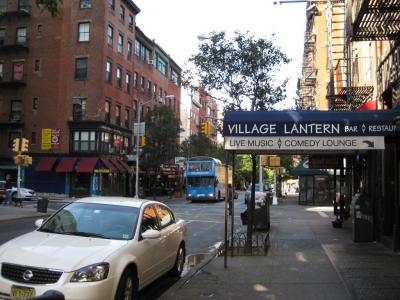
Then there’s the Comedy Cellar, a place where reservations matter more than menu items. You don’t come for the cuisine—you come for the ambush. This legendary basement has hosted everyone from Jerry Seinfeld and Aziz Ansari to Dave Chappelle dropping in for a surprise fifteen minutes. It’s intimate, electric, and absolutely no-photos-allowed. But you won’t miss the camera; you’ll be too busy laughing...
7
Caffe Reggio

7) Caffe Reggio

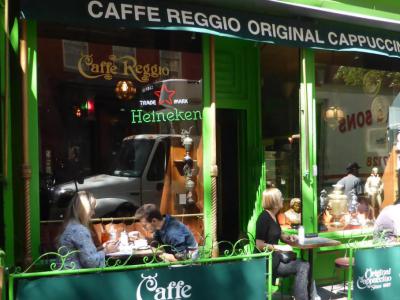
If you drift down MacDougal Street long enough, you’ll hit a little time portal disguised as a café. That’s Caffe Reggio—Greenwich Village’s long-running experiment in proving that the 1920s never really ended. It opened in 1927 thanks to Italian immigrant Domenico Parisi, a man determined to introduce New Yorkers to espresso at a time when most of the country thought “good coffee” meant whatever came out of a percolator. His secret weapon still sits right inside: a gleaming 1902 La Pavoni espresso machine, all brass curves and polished copper, looking less like an appliance and more like a ceremonial object stolen from an opera house. It’s the café’s crown jewel and the reason Reggio proudly claims to be the first spot in America to serve cappuccino.

From the very beginning, the place pulled in Greenwich Village’s bohemian crowd like a magnet. Writers, musicians, insomniac students, and anyone allergic to silence squeezed into the narrow room, drawn to its classical music, antique furniture, and lighting dim enough to make every conversation feel important. By the time the Village became a national stage for artistic rebellion and political debate in the mid-20th century, Reggio had already become its unofficial living room. Beats, folk singers, and half the neighborhood’s philosophers camped out here, scribbling in notebooks or arguing about everything except what time they should go home.

The café didn’t stop at hosting creative chaos; it played a supporting role in political conversations tied to the civil-rights era and even served as a casual hangout for local politicians. Hollywood eventually caught on, too—films like The Godfather Part II and Inside Llewyn Davis turned its vintage interior into a ready-made set.

Today, Caffe Reggio still leans fully into its old-world soul. You can sip a cappuccino, watch the Village glide by from a window seat, and enjoy the rare luxury of feeling like the past and present decided to share the same table...
8
Bleecker Street

8) Bleecker Street

Among the Village’s many legendary blocks, Bleecker Street is the one that refuses to fade into the background. Once the hangout of Beatnik poets, folk-music dreamers, and the off-Broadway crowd, it hasn’t retired its spotlight just yet. These days it’s still working overtime, thanks to Terra Blues, The Red Lion, and The Bitter End—New York’s oldest rock-’n’-roll club and a rite of passage for anyone who claims to “love live music.”

An afternoon on Bleecker has its own rhythm. You might wander into a record shop and lose track of time, then rediscover it over a slice of some of the city’s best pizzas. Maybe you’ll top that off with a sharp espresso and a bit of fashion-people-watching, especially west of Seventh Avenue, where the boutiques churn out downtown style in its natural habitat.

Food lovers, of course, have their own pilgrimage. Murray’s Cheese—at No. 254, open from early until late—is a wonderland of dairy temptation, deli treasures, and specialty goods you didn’t know you needed. Walk a little farther, and you meet Magnolia Bakery at No. 401, the cupcakerie that accidentally turned Manhattan into a frosting-powered metropolis.

And if you’re in the mood for something with an older soul, pause at the corner of Bleecker and Carmine. That striking Renaissance-style building is Our Lady of Pompeii, where Italian mosaics, graceful marble floors, and a painted dome quietly upstage the neighborhood’s nonstop buzz.

So, yes—Bleecker Street earns its reputation as one of New York’s most eclectic stretches. It also connects to some of the city’s loveliest side streets, including the postcard-worthy Bank Street, right in the heart of the Greenwich Village Historic District and surrounded by some of the finest 19th-century architecture you’ll find anywhere below 14th Street...

Walking Tours in New York, New York

Create Your Own Walk in New York

Create Your Own Walk in New York

Creating your own self-guided walk in New York is easy and fun. Choose the city attractions that you want to see and a walk route map will be created just for you. You can even set your hotel as the start point of the walk.
George Washington's New York

George Washington's New York

While not really a New York fan himself, George Washington held the city in high esteem, calling it “a post of infinite importance,” and is even credited with coining the term “New Yorker”. The scene of some of Washington’s greatest military trials and political triumphs, NYC is a home to several important sites associated with his life and career, such as Fraunces Tavern, Bowling Green,...  view more

Tour Duration: 1 Hour(s)
Travel Distance: 1.6 Km or 1 Miles
NYC's Chinatown and Little Italy Walking Tour

NYC's Chinatown and Little Italy Walking Tour

If New York were a giant cookbook, Chinatown and Little Italy would definitely be the chapters where flavors go wild. These two neighbors on Manhattan’s Lower East Side started as modest immigrant enclaves and somehow ended up becoming two of the city’s most recognizable cultural districts. Their stories mirror the bigger tale of New York itself: arrivals from faraway places, tight-knit...  view more

Tour Duration: 1 Hour(s)
Travel Distance: 1.6 Km or 1 Miles
Midtown Manhattan Walking Tour

Midtown Manhattan Walking Tour

If you’ve ever pictured New York City as a canyon of skyscrapers, glowing billboards, and streets that pulse with constant activity, Midtown Manhattan is the version you likely imagined. Hard to believe, but this buzzing district started out as open farmland—proof that even the busiest corners of the world have humble beginnings... Everything changed after the Commissioners’ Plan of 1811...  view more

Tour Duration: 2 Hour(s)
Travel Distance: 4.1 Km or 2.5 Miles
Manhattan Architecture Walking Tour

Manhattan Architecture Walking Tour

The skyscraper, which has shaped Manhattan's distinctive skyline, has been closely associated with New York City’s identity since the end of the 19th century. Despite the Great Depression, some of the world’s tallest skyscrapers were completed in Manhattan during the 1930s, including numerous Art Deco masterpieces that are still part of the city's skyline – most notably the Empire...  view more

Tour Duration: 2 Hour(s)
Travel Distance: 4.2 Km or 2.6 Miles
NYC Top Religious Sites Walking Tour

NYC Top Religious Sites Walking Tour

Other than high-risers, New York City is also famous for the variety of beautiful places of worship renowned for their architectural splendor. After 1830, inspired by a love for all things medieval imported from England, the Gothic style developed in the metropolis, as first illustrated by the Grace Church (1846). The best example of this style, however, remains St Patrick’s Cathedral, which...  view more

Tour Duration: 3 Hour(s)
Travel Distance: 7.0 Km or 4.3 Miles
Grand Central Station to Union Square

Grand Central Station to Union Square

Despite being smaller than almost everything around it, including the humongous MetLife Building that dwarfs it from behind, the Grand Central Terminal is just so gorgeous and palatial-looking that it still manages to be the centerpiece of the whole East Side of Midtown Manhattan. Passing from here to Union Square, our self-guided tour is bound to introduce you to some of New York City’s most...  view more

Tour Duration: 2 Hour(s)
Travel Distance: 3.8 Km or 2.4 Miles

Useful Travel Guides for Planning Your Trip

Bar Tour of Lower East Side, New York City

Bar Tour of Lower East Side, New York City

The Lower East Side has been described the most livable neighborhood in NYC. Unique and dynamic, LES has boutique shops, cafes and restaurants alongside great bars and museums.In this historic neighborhood, residents strive to preserve its roots. Here, you can find young professionals who challenge...
NYC Souvenir Guide: 15 Authentic New York City Products to Take Home

NYC Souvenir Guide: 15 Authentic New York City Products to Take Home

In keeping with the song, one might think that, if they can make it in New York City, they can make it anywhere. Well, not always... Some of the things made in New York City aren't made anywhere else, and you'll definitely want to try or keep at least some of them to prolong your NYC...
7 Best Drinking Places in Upper West Side, NY

7 Best Drinking Places in Upper West Side, NY

With “Bar Tour of the Upper West Side” sample a cross section from NYC’s great gamut of drinking establishments, including a Belgian Brasserie, a wine bar, Irish pubs, and one dive — just for fun! These spots offer something a little extra, like craft beers, inspirational artwork, a chance...
NYC Beer Tour

NYC Beer Tour

There are many great places to drink in New York City. Still, discerning connoisseurs are likely to find themselves awash in a sea of mediocre beer without first gaining a proper lay of the beer land. For those whose curiosity and taste buds urge them to venture beyond ubiquitious draft staples like...
NY Villages Best Tea and Coffee

NY Villages Best Tea and Coffee

This is a guide to the best tea and coffee shops and houses in the East, West, Washington Square and Greenwich Villages of Manhattan. None of these are chains, so tourists looking to avoid Starbucks can find sanctuary in this app. All of these run the gamut between W and E 14th Streets, and down 1st...